
I’ve been a trader and investor for 44 years. I left Wall Street long ago—-once I understood that their obsolete advice is designed to profit them, not you.
Today, my firm manages around $5 billion in ETFs, and I don’t answer to anybody. I tell the truth because trying to fool investors doesn’t help them, or me.
In Daily H.E.A.T. , I show you how to Hedge against disaster, find your Edge, exploit Asymmetric opportunities, and ride major Themes before Wall Street catches on.
Table of Contents
H.E.A.T.
OpenAI is reportedly considering drastic token-price cuts. Enterprises are routing around frontier models to save up to 95% per task. The SDLLMTK Index just fell 14% in two weeks. And Oracle is planning roughly $70 billion in new data-center spend. Cheap tokens and expensive infrastructure are happening simultaneously -- and the investment implications of that collision are not what consensus expects.
KEY METRICS AT A GLANCE 14% SDLLMTK Index decline, 2 weeks | $638B Oracle RPO | $75B Oracle prepaid AI hardware | Up to ~95% cost reduction via model routing (selected configs) | Up to ~50x Fable 5 vs. DeepSeek V4 Pro output premium |
THE COLLISION
The AI price war is real. The infrastructure bill is still going up.
That is the collision.
OpenAI is reportedly considering drastic token-price cuts as Anthropic gains share in enterprise adoption. Ramp's June AI Index shows Anthropic at 41.0% of U.S. businesses versus OpenAI at 39.5%. The reflexive bull read is simple: lower prices, more usage, bigger market. Maybe. But a price cut is also a margin test -- it reveals which parts of the AI stack have real scarcity and which parts were only renting it.
At the same time, Oracle is still leaning hard into AI infrastructure: negative $23.7 billion in FY2026 free cash flow, $638 billion of remaining performance obligations, $75 billion of prepaid and customer-supplied hardware tied to large AI contracts, and a planned financing raise of roughly $40 billion for FY2027. The Financial Times reports Oracle is planning roughly $70 billion of data-center spend in the coming year. The capex machine is not slowing just because enterprise token buyers are getting more disciplined.
Cheap tokens and expensive infrastructure are happening simultaneously. That tells you the bottleneck has moved -- from capability to monetization. The question for investors is no longer who builds the fastest model. It is who makes AI cheaper, governable, routable, observable, and electrically possible.
TOKENMAXXING IS OVER
A few months ago, the dominant management metric inside some of the most sophisticated technology companies in the world was token usage. Not revenue per user. Not shipped features. Not customer outcomes. Tokens consumed.
Meta built an informal employee leaderboard. Amazon reportedly had engineers running AI agents on meaningless tasks just to inflate usage stats -- a textbook Goodhart's Law outcome. Uber burned through its entire 2026 agentic AI budget in four months. Salesforce accumulated a projected $300 million Anthropic bill in a single year. CEO Marc Benioff publicly wished for a smart router that could steer cheap queries to cheap models -- the CFO's version of buyer's remorse.
GitHub already made the structural turn explicit: the old request-based model could not absorb agentic usage costs, so Copilot moved to token-based AI Credits on June 1, 2026. When GitHub reprices a flagship developer product, it is not a pricing experiment. It is a signal that the meter has flipped permanently.
Then came the corrections. Meta took down the leaderboard. Microsoft cancelled Claude Code subscriptions in key product divisions. Uber's COO Andrew Macdonald acknowledged publicly that the company could not draw a straight line from AI token consumption to new features shipped to users. 'If you are not actually able to draw a direct line to how much useful features and functionality you are shipping to your users,' he said, 'the token costs are harder to justify.'
ANDREW BOSWORTH -- CTO, META PLATFORMS, APRIL 2026 INTERNAL MEMO "Nobody should be using AI tools just for the sake of using them. All motion is not progress and token usage alone is not a measure of impact of any kind." |
Fortune's headline summarized it precisely:

Tokenmaxxing is over. That is because it never measured what really counts. Tokens were a proxy for effort. They were never a proxy for results.
The reversion from tokenmaxxing to ROI discipline is not a sign that AI has failed. It is a sign that AI is maturing. The question for investors is who benefits when the proxy metric dies and the real one takes its place.
THE PRICE WAR: WHAT IT ACTUALLY MEANS
OpenAI's contemplated price cuts are a response to a two-front competitive squeeze. On the premium end, Anthropic has pulled ahead in enterprise adoption. On the commodity end, DeepSeek's share of AI usage on Vercel jumped from 1% in April to 17% in May 2026. More than 500 organizations have migrated from proprietary to open-source models on OpenRouter.
The economics are direct. Anthropic's Fable 5 carries an output-token premium of up to roughly 50 times DeepSeek V4 Pro, depending on workload mix and routing provider. For a customer routing 90% of workload through cheaper alternatives -- as Detail's founder Dan Robinson described publicly -- the savings are not marginal. They are existential to the incumbent pricing model.
SAM ALTMAN -- CEO, OPENAI, JUNE 2026 "Costs have suddenly become a huge issue. I think we'll have a lot of ways we can help people get more value for less spend." |
Citadel Securities quantified the structural shift: the SDLLMTK Index has fallen 14% in two weeks. Citadel notes the index falls when individual model prices decline, when users substitute toward more efficient models, or when the market diversifies away from expensive concentration. All three are happening simultaneously.
CITADEL SECURITIES -- GLOBAL MACRO STRATEGY, JUNE 2026 "Even the most powerful technologies must pass through the prosaic discipline of cost curves, capacity constraints, and marginal returns. Adoption is therefore becoming less about what frontier models can do in principle and more about the price and scarcity of the inputs required to make AI operational at scale. We see growing signs of a bifurcation in frontier vs. everyday AI usage." |
The reflexive bull reading: lower prices drive more usage, the market expands, everybody wins. Maybe. But a price cut is also a margin test. It forces the question that bull cases have successfully avoided: which parts of this stack have real scarcity, and which parts were only renting it?
THE BIFURCATION: TWO STACKS, TWO INVESTMENT CASES
The Citadel framework and the bottleneck migration thesis converge on the same structural conclusion: the AI market is bifurcating into two distinct tiers that require two distinct investment approaches.
FRONTIER TIER -- Narrow, defensible, premium-priced Drug discovery. Complex financial modeling. Advanced code generation. High-stakes legal analysis. These applications require frontier capability, can absorb frontier pricing, and are served by firms with proprietary data, deep research infrastructure, and operating domains where expensive inference still generates positive ROI. Anthropic Fable 5 output tokens carry an up to 50x premium over DeepSeek V4 Pro. For the right use case, that is still cheap. | COMMODITY TIER -- Broad, price-sensitive, margin-compressing HR workflows. Customer service. Internal search. Content summarization. Basic coding assistance. Real use cases, volume-generating, and scaling -- but migrating toward model routing, cached tokens, open-source weights, and in-house fine-tunes. DeepSeek share on Vercel: 1% in April to 17% in May 2026. Over 500 organizations have migrated from proprietary to open-source on OpenRouter alone. |
The problem for current valuations is that they were not priced for bifurcation. They were priced for universal frontier adoption -- every enterprise running every workflow through the most capable, most expensive models available. That assumption is now demonstrably wrong. The repricing is underway.
THE LUCENT PARALLEL: WHEN INFRASTRUCTURE FEEDS THE BEAST
There is a pattern in technology buildouts that deserves naming directly. In 1999-2000, Lucent Technologies was the Magnificent Seven name of its era -- a market darling whose growth story became a prison. To sustain the revenue growth its multiple demanded, Lucent extended its own balance sheet and credit rating to less creditworthy telecom customers, effectively financing the demand it needed to justify its own stock price. When those customers could not pay, the demand evaporated. Lucent fell 99%.
Now read Oracle's numbers carefully. Negative $23.7 billion in FY2026 free cash flow. $638 billion of RPO. $75 billion of prepaid and customer-supplied hardware tied to large AI contracts. Roughly $70 billion of planned data-center spend in the coming year. That is not a company that believes the infrastructure buildout is slowing. That is a company that needs the buildout to continue -- because the alternative is that the tens of billions already committed to AI hardware depreciates on a schedule the income statement cannot absorb.
And then there is this: OpenAI is reportedly in advanced negotiations to lease a proposed 10-gigawatt data center campus on federal land in Ohio, potentially with financial backing from Nvidia.
That is the Lucent question. When suppliers, hyperscalers, and cash-burning model companies start signing ever-larger circular infrastructure commitments, investors have to ask whether end-demand is pulling the buildout forward -- or whether the buildout is financing the demand it needs to justify itself.
This is not the base case. But at current multiples for infrastructure-adjacent names, the market is not pricing in the possibility at all.
TIERED WINNERS AND LOSERS
TIER | CATEGORY | EXAMPLES | THESIS | RISK |
BEST-POSITIONED | Power Delivery / Grid | ETN, PWR, GEV, HUBB, VRT, NVT | AI capex hits the grid at both frontier and commodity tiers. Oracle's $70B planned data-center spend signals the infrastructure arms race is multi-year regardless of token pricing. Electrons are the one input that cannot be open-sourced or routed around. | Regulatory delays; utility capex cycles slow to approve |
BEST-POSITIONED | Custom Silicon / ASICs | AVGO, MRVL; GOOG TPU, AMZN Trainium | Token commoditization favors efficiency chips over raw FLOP counts. As Anthropic and OpenAI race to cut price per token, cost-per-token wins -- and ASICs own that math. Hyperscaler ASIC programs are accelerating, not slowing. | Merchant semi demand weakens if hyperscaler capex slows; program concentration risk |
BEST-POSITIONED | AI Cost Governance / Observability | DDOG, DT, SAIL | Salesforce's ~$300M Anthropic bill -- and Benioff's public wish for a smart router -- is the product roadmap. When token costs are variable and visible, CFOs buy the control layer. GitHub's move to usage-based billing makes this infrastructure, not optional. | If AI spend stalls broadly, the governance layer slows with it |
SELECTIVE EXPOSURE | Model Routing / Hybrid Stack | Factory, Lovelace AI, Lindy (private); hyperscaler-native routing emerging | Dynamic routing achieves up to 95% cost reduction in selected configurations. Whoever owns the routing layer owns enterprise AI economics in the commodity tier. Near-term, this is a real value-creation lever. | Rapidly commoditizing; hyperscalers building natively; binary acquisition risk |
SELECTIVE EXPOSURE | Networking / Interconnects / CPO | ANET, AVGO, MRVL, COHR, LITE | Inference clusters require low-latency fabric at both tiers. Oracle's $70B data-center buildout is a forward indicator for networking spend. CPO transition extends upgrade cycles. | Build cycle partially priced; CPO timeline uncertain; commodity routing may use simpler switching |
SELECTIVE EXPOSURE | Frontier Labs (hyperscaler proxies) | MSFT, GOOGL as OpenAI/Anthropic proxies | Narrow frontier use cases remain high-margin if pricing power holds. Proprietary data moats and inference scale advantages are real -- but only while frontier-tier differentiation is measurable. | Enterprise migration to commodity models may outpace consensus; OpenAI/Anthropic IPO lock-up dynamics; price war margin erosion |
PRESSURE POINT | Mid-Tier AI SaaS Without Data Moats | Generic copilots, undifferentiated RAG platforms | Margin compression is structural as underlying model costs crater. Competition intensifies from hyperscaler-native features. The Lucent parallel: volume without moat is a growth story that ends in debt. | Binary outcome: acquisition at premium possible; keep sizing tight |
PRESSURE POINT | Training-Only / Uncontracted GPU Leasing | Spot GPU cloud providers, training pure-plays without contracted demand | Token deflation compresses per-inference revenue. Training demand slows as models mature and fine-tuning replaces retraining. Uncontracted GPU exposure is a 2026-2028 earnings risk, not an immediate trade. | Near-term datacenter demand still robust; Oracle $638B RPO shows contracted demand is real |
PRESSURE POINTS TO MONITOR
PRESSURE POINT | MECHANISM | SIGNAL TO WATCH |
Token Price Floor | OpenAI's contemplated cuts force Anthropic, Google, and open-source providers to respond. The SDLLMTK index is already down 14% in two weeks -- partly price deflation, partly migration to cheaper models. The two reinforce each other in an elastic demand market. | Month-over-month changes on OpenAI/Anthropic pricing pages; spread between flagship and mini tier; SDLLMTK index level |
Enterprise Tokenmaxxing Reversal | Meta pulled its internal leaderboard. Microsoft cancelled Claude Code subscriptions in key divisions. Uber burned its 2026 token budget in four months. Salesforce projected ~$300M in Anthropic spend. The correction from proxy metrics to ROI discipline is underway and accelerating. | Quarterly AI spend-per-employee data (Ramp AI Index); Fortune 500 AI cost rationalization language on earnings calls; enterprise token budget disclosures |
Open-Source Substitution Velocity | DeepSeek share on Vercel: 1% April to 17% May. OpenRouter: 500+ orgs migrated from proprietary to open-source. Fable 5 output tokens carry up to ~50x premium over DeepSeek V4 Pro. The math does not require a conspiracy -- it requires a CFO. | DeepSeek/Llama enterprise adoption curves; OpenRouter model share data; Hugging Face enterprise tier growth |
Oracle Capex Signal | Oracle reported negative $23.7B FY2026 free cash flow, $638B RPO, and $75B of prepaid/customer-supplied hardware tied to large AI contracts. FT reports roughly $70B of planned data-center spend in the coming year. Infrastructure acceleration is happening alongside enterprise token rationalization -- simultaneously, not alternately. | Oracle, MSFT, GOOGL, AMZN quarterly capex vs. revenue growth; 'capex optimization' language on earnings calls as the inverse tell |
Depreciation Cliff | Hyperscalers are sitting on hundreds of billions in AI hardware with 3-5 year useful lives. If utilization disappoints, depreciation becomes a GAAP earnings headwind that cannot be adjusted away -- unlike stock compensation. | GAAP vs. non-GAAP EPS spread at MSFT, GOOGL, AMZN; disclosed useful-life assumption changes; CapEx-to-Revenue ratio trend |
CREDIBILITY FIREWALL
SOURCED / REPORTED | DATA / MODEL-DERIVED | EDITORIAL VIEW |
OpenAI reportedly considering drastic token price cuts: WSJ, June 10, 2026. Reuters could not independently verify. Discussions described as still in flux. WSJ 'AI Price War Is Here,' June 11, 2026. Fortune 'Tokenmaxxing Is Over,' Jeremy Kahn, May 28, 2026. Citadel Securities Global Macro note / SDLLMTK Index data, June 2026. Oracle Q4 FY2026 earnings: negative $23.7B FCF, $638B RPO, $75B prepaid hardware. Oracle ~$70B planned data-center spend: Financial Times, June 2026. Salesforce ~$300M Anthropic spend: Marc Benioff, Business Insider, May 2026. Meta leaderboard removed; Microsoft Claude Code cancelled; Uber budget exhausted: FT/The Verge/Fortune, May-June 2026. GitHub usage-based billing: GitHub Blog, June 1, 2026. DeepSeek/OpenRouter share data: WSJ, June 11, 2026. | Hyperscaler capex estimates from consensus analyst models. Hardware useful-life estimates (3-5yr) per public SEC filings. Up to ~50x output-token premium: derived from Anthropic published pricing vs. OpenRouter/DeepSeek V4 Pro pricing as of June 2026; actual ratio is input/output mix and provider dependent. Up to ~95% cost reduction via model routing: sourced from named executives in WSJ, June 11, 2026; highly workload-dependent. | Frontier/commodity bifurcation is editorial interpretation of cited research. Lucent Technologies parallel is analytical framing, not prediction. 'Tokenmaxxing reversal as structural shift' is the newsletter's thesis -- the evidence supports it; magnitude is uncertain. Tier assignments are analytical framing, not personalized buy/sell recommendations. |
BEAR CASE SPOTLIGHT
THE LUCENT SCENARIO This is not the base case. It is the risk that current valuations are not compensating you to take. In 1999-2000, Lucent Technologies was the Magnificent Seven name of its era -- a market darling whose growth story became a prison. To sustain the revenue growth its multiple demanded, Lucent extended its own balance sheet and credit rating to less creditworthy telecom customers, effectively financing the demand it needed to justify its own stock price. When those customers could not pay, the demand evaporated. Lucent's stock fell 99%. Oracle is now reporting negative $23.7B FY2026 free cash flow, $638B of RPO, and planning roughly $70B of new data-center spend. OpenAI is reportedly in advanced negotiations to lease a proposed 10-gigawatt data center campus on federal land in Ohio, potentially with financial backing from Nvidia. That is the Lucent question. When suppliers, hyperscalers, and cash-burning model companies start signing ever-larger circular infrastructure commitments, investors have to ask whether end-demand is pulling the buildout forward -- or whether the buildout is financing the demand it needs to justify itself. The AI bear case is not that the technology fails. It is that AI becomes the most transformative technology in human history -- and still manages to be a difficult investment at current multiples -- because capital costs are relentless, commodity models drain the revenue pool, and depreciation hits the P&L before promised productivity gains show up in enterprise budgets. Airlines are indispensable. They collectively destroyed $60 billion in shareholder capital between 1978 and 2010. |
FIVE TAKEAWAYS
1. The price war is a margin test, not proof of failure. Lower token prices can unlock usage volume -- but they also expose where differentiation is real and where it was rented. Which tier you own determines whether deflation helps or hurts your position.
2. Tokenmaxxing is over; ROI discipline has replaced it. Meta, Microsoft, Uber, Salesforce -- the largest AI spenders in the world are rationalizing token consumption simultaneously. This is the inevitable transition from experimentation to accountability. The companies that benefit are those selling accountability infrastructure: observability, governance, model routing.
3. Bifurcation is the base case -- and valuations have not caught up. Frontier models keep premium economics in narrow, high-value domains. Commodity inference routes to cheaper models, open-source weights, and in-house fine-tunes. Current multiples assume the frontier is universal. It is not. The repricing is structural, not cyclical.
4. The cleanest AI trade is still infrastructure -- but watch the Lucent signal. Power delivery, custom silicon, networking, and observability benefit from both tiers of AI usage. They do not care whether the winning model costs $30 or $0.30 per million tokens. But if infrastructure capex keeps expanding while enterprise demand for premium tokens contracts, the depreciation cliff becomes a GAAP earnings problem that cannot be adjusted away. Oracle's $638B RPO says contracted demand is real. The question is whether it stays that way.
5. The bottleneck has shifted from capability to monetization. The next winners convert cheap intelligence into governed, reliable, profitable workflows -- not the companies with the most impressive benchmark. Token deflation does not mean AI demand is fake. It means the profit pool is moving. Follow the bottleneck.
The AI Buildout Has a Physical Layer

Many of today’s data centers are still using copper wiring. The same metal we’ve been using for a hundred years.
At the speeds AI demands with data moving between thousands of GPUs, billions of times a second, copper doesn’t just slow down.
It turns that data into heat. The more you push through it, the worse it gets. There’s no software for fix for that.
So what’s the answer?
Explore the Photonics Layer…..
Tuttle Capital Pure Play Photonics ETF (FOTO)
Distributor: Foreside Fund Services | Investing involves risk including possible loss of principle.
News vs. Noise: What’s Moving Markets Today
Here are my comments to Fox Business News yesterday…..
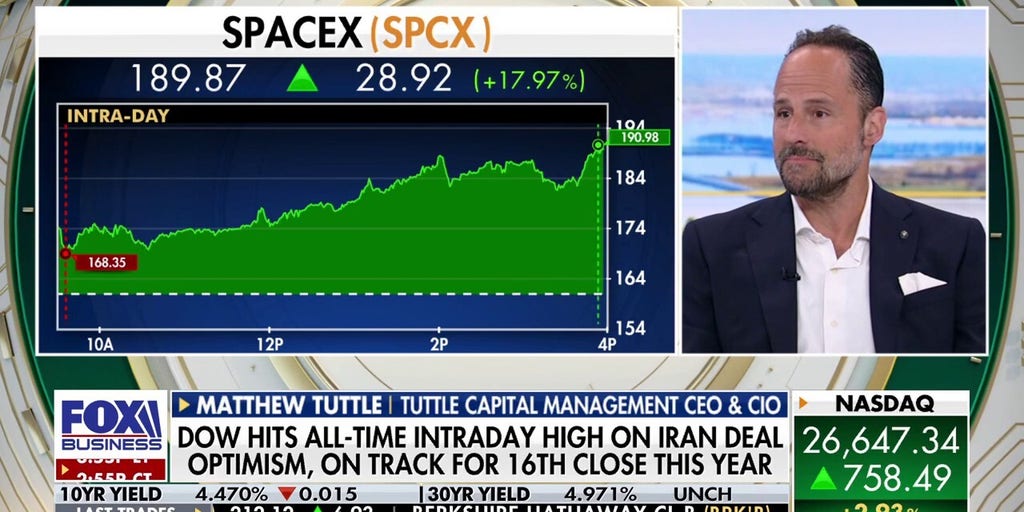
Speaking of $SPCX ( ▲ 1.22% ), the options start trading today which could exacerbate moves. It’s already up near 11% pre market, and the options don’t kick in until the open.
Continue to watch rates here. Yesterday, and so far this morning, we are seeing oil plummet. Trump and Bessent have been saying higher oil prices, and therefore higher inflation, are temporary. I’m not so sure, but this drop in oil should have led to a decent drop in rates if the market starts to think the Fed won’t raise, and could cut…..

Not really seeing that yet.
Where Does the Money Go When AI Hits a Wall?

When capital chases a tech theme, it tends to pile into the most obvious
layer and miss the one underneath. AI spending is now bumping hard
against memory. Hyperscalers — the big cloud builders like Amazon,
Google, and Microsoft — have shifted memory from 8% of their build
budgets to an estimated 30% in a single cycle. That capital has to go
somewhere. If the constraint is memory, and the build can't move without
it, shouldn't an investor own the layer AI runs on?
View HBMX fund holdings →
Distributor: Foreside Fund Services | Investing involves risk including
possible loss of principal.
<Link = http://www.hbmxetf.com/>
ETF News
$HALX ( ▲ 0.26% ) & $UFOD ( ▲ 0.68% ) Holdings Update: |
We added $SPCX ( ▲ 1.22% ) to both ETFs yesterday: https://www.thetruthisoutthereufod.com/ |
A Stock I’m Watching

Gold stocks ripping on another cease fire. Would like to see this break back above the 200 day moving average.
In Case You Missed It
The H.E.A.T. (Hedge, Edge, Asymmetry and Theme) Formula is designed to empower investors to spot opportunities, think independently, make smarter (often contrarian) moves, and build real wealth.
The views and opinions expressed herein are those of the Chief Executive Officer and Portfolio Manager for Tuttle Capital Management (TCM) and are subject to change without notice. The data and information provided is derived from sources deemed to be reliable but we cannot guarantee its accuracy. Investing in securities is subject to risk including the possible loss of principal. Trade notifications are for informational purposes only. TCM offers fully transparent ETFs and provides trade information for all actively managed ETFs. TCM's statements are not an endorsement of any company or a recommendation to buy, sell or hold any security. Trade notification files are not provided until full trade execution at the end of a trading day. The time stamp of the email is the time of file upload and not necessarily the exact time of the trades. TCM is not a commodity trading advisor and content provided regarding commodity interests is for informational purposes only and should not be construed as a recommendation. Investment recommendations for any securities or product may be made only after a comprehensive suitability review of the investor’s financial situation.© 2026 Tuttle Capital Management, LLC (TCM). TCM is a SEC-Registered Investment Adviser. All rights reserved.