
I’ve been a trader and investor for 44 years. I left Wall Street long ago—-once I understood that their obsolete advice is designed to profit them, not you.
Today, my firm manages around $5 billion in ETFs, and I don’t answer to anybody. I tell the truth because trying to fool investors doesn’t help them, or me.
In Daily H.E.A.T. , I show you how to Hedge against disaster, find your Edge, exploit Asymmetric opportunities, and ride major Themes before Wall Street catches on.
Table of Contents
H.E.A.T.
The infrastructure underneath every AI application — compute, memory, power, grid, networking — is compounding whether the chatbot delivers or not. The fortunes are not in the application. They are in the bottlenecks every future application must pass through.
$7.6T AI infrastructure capex, 2026–2031 (Goldman Sachs) | 2× Global data-center electricity demand by 2030 (IEA) | 40% Of companies measuring AI savings fell below 10% (Bain, June 2026) | 200M Protein structures predicted by AlphaFold2 (Nobel Committee) |
THE SETUP
June 1, 2026. Bain & Company publishes a report with a headline designed to rattle boardrooms: "Your AI Budget Is Growing. Your Returns Aren't. Here's Why."
By 9 AM it was everywhere. CNBC chyrons. LinkedIn virtue-signaling. The usual suspects declaring the AI bubble punctured.
Here is the thing: Bain is not wrong.
Enterprise AI ROI is genuinely uneven. Most companies are still nowhere near fully autonomous workflows. Cost savings are falling short of projections. These are real problems.
That is the adoption layer. This issue is about the infrastructure layer.
You do not need every corporate chatbot to work this quarter for power delivery hardware, HBM, networking, and data-center capex to keep compounding. The infrastructure buildout does not care whether your company's AI saved the accounting department 11 hours a week.
What happened in railroads: the user-facing transportation story was chaotic and speculative for decades. The track, the steel, and the signal infrastructure compounded relentlessly.
What happened in telecom: the dot-com application layer exploded in 2000. The fiber in the ground kept running.
AI infrastructure is five years old. The application layer is disappointing early adopters. The physical layer — compute, memory, power, networking — is still getting built. That is the trade.
"The adoption layer can disappoint while the infrastructure layer compounds. The question is where the bottleneck sits today — not where it was last year."
THREE ENGINES. TWO REGIME VARIABLES.
Most analysts present AI as one monolithic theme. That is how you get confused when Bain publishes a report about chatbot ROI and the semiconductor cycle is at all-time highs simultaneously.
The cleaner frame: there are three engines creating the opportunity, and two regime variables that decide when you get paid.
The engines: AI compute infrastructure. Power and grid infrastructure. AI-enabled productivity (automation, scientific discovery, labor substitution). These are compounding secular forces. They do not stop because enterprise ROI is uneven.
The regime variables: Global liquidity and policy/geopolitics. These do not create the wealth — they decide the timing and the multiple. When liquidity is supportive, the engines get priced. When it tightens, even correct theses get sold.
Understanding which category a given stock belongs to is the whole game.
ENGINE #1 — AI COMPUTE INFRASTRUCTURE
The compute buildout is the most obvious force and the most widely owned. But being obvious does not mean it has been fully extracted — it means the bottleneck within it matters more than the headline.
Right now the binding constraint in AI compute is not raw processing power. It is memory bandwidth — specifically the high-bandwidth memory sitting between the GPU and the data it needs to process. Every NVIDIA Blackwell cluster built in 2026 moves through this pinch point.
SK Hynix is not a monopolist — Samsung and Micron each hold roughly 21% global HBM share. But SK Hynix commands 58% of HBM supply (Reuters, June 2026) and remains Nvidia's leading supplier. That is the current dominant position on the highest-margin constraint layer in AI infrastructure.
The question is not whether that position persists forever. It is whether you own it while it does.
The next constraint migration is already visible: as HBM becomes more commoditized, the bottleneck shifts to advanced packaging, interconnect, and networking. TSMC's CoWoS packaging capacity, ANET's AI ethernet switches, and the silicon photonics layer underneath both are the next tollbooths.
ENGINE #2 — POWER & GRID INFRASTRUCTURE
This is the strongest trade in the piece, and the most underpriced relative to the mandate.
The IEA's base case: global data-center electricity consumption roughly doubles to approximately 945 TWh by 2030. U.S. data-center consumption rises +130% from 2024 levels. The grid as currently configured cannot support what hyperscalers have already financed.
Microsoft did not restart Three Mile Island on a whim. Constellation signed a 20-year power purchase agreement that supports the planned restart of Three Mile Island Unit 1 — the Crane Clean Energy Center — with Microsoft purchasing the power for data-center load matching. That is a 20-year, gigawatt-scale acknowledgment that the grid problem is structural, not temporary.
Google is signing nuclear capacity agreements that will not come online for five years. Amazon is building utility-scale solar-plus-storage at record pace. Every one of these contracts is an implicit admission: the electrons are the bottleneck.
The investment implication is direct. Power generation, transmission hardware, substation-to-rack electrical equipment, and grid management software are all tollbooth plays on the AI buildout — with the additional characteristic that they carry regulated or contracted cash flows rather than speculative AI multiples.
ENGINE #3 — AI-ENABLED PRODUCTIVITY
This engine moves slower than the infrastructure buildout, but its durability is longer and its eventual scale is larger.
The aging West combined with AI productivity gains is not a contradiction — it is a business model. When there are not enough workers to fill the roles that need filling, automation becomes mandatory rather than optional.
But the highest-resolution expression of this engine is not automation software. It is AI as a discovery engine — the use of machine learning to generate genuinely new scientific knowledge that human researchers could not reach in reasonable time.
AlphaFold2 predicted the structure of virtually all 200 million known proteins and has been used by more than two million researchers across 190 countries (Nobel Committee, 2024). The protein folding problem was unsolved for 50 years. AI solved it in one training run.
That is not an incremental productivity improvement. That is a category change in what research is possible.
The tactical point: AI is compressing early discovery and preclinical work in drug development. It has not yet repealed clinical-trial failure rates or full approval timelines. The companies positioned on the discovery layer — not the clinical layer — carry the best risk-adjusted upside in this engine.
The companies winning here are building real agents and automated workflows, not deploying chatbots and calling it transformation. That distinction is what the Bain report is actually measuring — and they are right that most companies have not made it yet.
THE REGIME VARIABLES
Regime Variable #1 — Global Liquidity The engines create the opportunity. Global liquidity decides whether the market pays you now or later. When central bank balance sheets are expanding and credit conditions are loose, risk assets tied to secular growth themes dramatically outperform. When liquidity tightens, even correct theses get de-rated. This is not a reason to sell the thesis — it is a reason to size the position to your liquidity model, not your conviction level. Current environment: still supportive. Watch for tightening signals before reducing high-beta exposure. When the model turns, reduce — but keep the watchlist intact for re-entry. |
Regime Variable #2 — Policy & Geopolitical Alignment Government decisions act as multipliers or vetoes on all three engines. They do not create wealth independently — but they can accelerate a tailwind into a supercycle or flip a headwind into a structural loss. The most relevant current signal: the US-China semiconductor cold war. CXMT's emergence as a Chinese DRAM competitor is real. The policy response — export controls, ally coordination, CHIPS Act incentives — will define which memory manufacturers enjoy protected margins for the next five years. A company building AI infrastructure in a jurisdiction with favorable energy policy and protected semiconductor access is worth more than its identical twin operating in a hostile regulatory environment. That premium is not temporary — it is structural, and it is underpriced in most screener-based analyses. |
THE BOTTLENECK STACK — WINNERS BY LAYER
Tiered position matrix — own the constraint layer, not the headline
Layer | Names | Engine | Why It's a Tollbooth | Risk |
HBM / Memory | SK Hynix (000660.KS), MU | Engine #1 | 58% HBM share; dominant on the memory bandwidth constraint. Micron is the catch-up play. | Samsung / CXMT close gap; margin compression |
Semi Tools / Packaging | ASML, TSM, AMAT, LRCX, KLAC | Engine #1 | EUV, deposition, etch, and CoWoS advanced packaging — the constraint layer after HBM. | Export controls complicate TSM/ASML China exposure |
Interconnect / Networking | ANET, AVGO, MRVL, COHR, LITE | Engine #1 | AI cluster networking is the next bottleneck after memory and power. Ethernet and photonics. | InfiniBand vs. ethernet standards war; NVDA vertical integration |
Power Delivery Hardware | VRT, ETN, PWR, GEV, HUBB | Engine #2 | Substation-to-rack electrical equipment. Contracted demand. Not speculation — physical requirement. | Lead times and backlog; valuation already elevated |
Nuclear / 24/7 Power | CEG, VST | Engine #2 | 20-year hyperscaler PPAs at premium rates. Firm, carbon-free power commands scarcity pricing. | Regulatory delays; new-build cost overruns |
Workflow Automation | PLTR, NOW | Engine #3 | Real enterprise process redesign — not chatbots. The companies that close Bain's ROI gap. | Long sales cycles; Bain-style budget skepticism spreads |
AI Science / Biotech | RXRX, SDGR | Engine #3 | AlphaFold-class discovery compression. High upside, high burn — proof-of-concept layer. | Clinical-trial failure rates unchanged; cash runway |
⚠ Avoid | Utilities without contracted growth | — | No contracted load growth, no interconnection advantage, no regulatory cost recovery — same capex cycle, none of the premium. | Not the same as all gas/coal |
⚠ Avoid | Generic enterprise SaaS | — | Being disrupted from below by AI-native competitors. Legacy CRM/HR vendors without embedded AI workflows face multiple compression. | Disruption may be slower than feared |
PRESSURE POINTS TO WATCH
Signal | What It Means | Action |
Samsung / Micron HBM4E qualification news | Tests whether SK Hynix's HBM premium is peaking. A qualified competitor narrows the moat. | Watch SK Hynix margin guidance; shift weight toward packaging/networking if moat narrows |
CXMT HBM3/HBM3E progress | China competition risk. More relevant to future pricing than 2026 Nvidia supply chain. | Monitor geopolitical response — export control escalation is the counterweight |
Hyperscaler capex guidance revisions | The master demand signal for the entire bottleneck stack. | Reduce high-beta exposure on cuts; re-enter on next pocket pivot after stabilization |
Grid interconnection delays (queue data) | Positive for behind-the-meter and grid hardware; negative if projects cancel rather than delay. | Differentiate — delays favor VRT/ETN/HUBB; cancellations are different risk |
Credit spreads / project-finance costs | Critical for data-center landlords, utilities, and renewables. Tightening = project delays. | Watch investment-grade spreads as a leading indicator for power infrastructure capex |
Global liquidity model signal | Regime variable. Secular forces intact; market timing changes. | Reduce high-beta exposure when negative; keep watchlist intact for re-entry |
CREDIBILITY FIREWALL
✅ CONFIRMED
Bain & Company, "Your AI Budget Is Growing. Your Returns Aren't. Here's Why," published June 1, 2026. Survey-based; 40% of companies measuring AI savings landed below 10%. 90% are still increasing budgets.
Goldman Sachs: AI infrastructure capex estimated at $765B annually in 2026, rising to $1.6T annually in 2031, with approximately $7.6T cumulative through 2031 ("Tracking Trillions: The Assumptions Shaping the Scale of the AI Build-Out").
IEA, Energy and AI report: global data-center electricity consumption roughly doubles to approximately 945 TWh by 2030. U.S. data-center electricity consumption rises approximately 130% from 2024 levels.
Constellation Energy confirmed a 20-year power purchase agreement to support the restart of Three Mile Island Unit 1 (Crane Clean Energy Center), with Microsoft purchasing the output for data-center load matching. Announced September 2023; operational restart targeted 2028.
SK Hynix held approximately 58% global HBM share in Q1 2026, with Samsung and Micron each at 21%. SK Hynix is Nvidia's leading HBM supplier. Source: Reuters, June 2, 2026.
AlphaFold2 predicted the structure of virtually all 200 million known proteins and has been used by over two million researchers in 190 countries. Nobel Prize in Chemistry 2024 awarded to Demis Hassabis and John Jumper.
⚡ DIRECTIONAL (High Conviction, Watch for Confirmation)
CXMT (ChangXin Memory Technologies) is advancing toward HBM3/HBM3E qualification. Commercially viable timeline estimated 2026–2027; not independently confirmed as of press time.
AI compressing full drug approval timelines from 12 years toward 3 is directional. Validated for early discovery and preclinical work. Clinical-trial failure rates and full approval timelines have not been demonstrably shortened in peer-reviewed longitudinal studies as of June 2026.
Hyperscaler AI capex sustaining at Goldman-projected levels through 2031 is directional. Contingent on continued enterprise AI adoption, geopolitical stability, and absence of major technical setbacks.
THE BEAR CASE
The three-engine thesis has one genuine Achilles heel, and it is not the Bain report.
It is valuation. Vertiv trades at roughly 40x forward earnings. Vistra has tripled in eighteen months. SK Hynix is priced for HBM dominance that Samsung and CXMT are actively working to erode. Buying the right thesis at the wrong price is still a way to lose money.
The second bear case is policy whiplash. A new regulatory framework on AI energy consumption, a nuclear regulatory reversal, or a shift in CHIPS Act funding — any of these could reset the timeline on Engine #2 specifically and trigger a broad risk-off rotation. The regime variables can veto the engines.
The third bear case: the Bain report is early but not entirely wrong. If enterprise ROI disappointment spreads from boardrooms to capital allocation decisions, hyperscaler capex guidance could disappoint as early as Q3 2026 — pulling the entire infrastructure stack with it. Infrastructure dependency assumes the infrastructure keeps getting built.
None of these scenarios ends the story. They create re-entry points. The discipline is knowing the difference between a pause and a peak — and having the liquidity model to tell you which one you're in.
FIVE TAKEAWAYS
1. Bain is the bear case, not the conclusion. Enterprise AI ROI is uneven. Infrastructure dependency remains intact. These are not contradictory facts — they are two different layers of the same story.
2. Own the constraint layer. The money migrates from GPU to HBM, to packaging, to networking, to power, to cooling, to grid delivery as each bottleneck is solved. Follow the constraint, not the brand.
3. Power is the cleanest 2026–2028 AI trade. The grid is not ready for what hyperscalers have already financed. Contracted, firm power generation and electrical delivery hardware carry real cash flows — not speculative AI multiples.
4. Liquidity decides the multiple, not the thesis. Secular forces create the opportunity; global liquidity decides whether the market pays you now or later. When the model turns negative, reduce high-beta exposure and keep the watchlist intact.
5. The cycle is not over — but the easy trade changes. The winner is not whoever owns last year's bottleneck. It is whoever owns the next one. The question is not whether AI is real. It is where the constraint sits today.
AI adoption can disappoint while AI infrastructure compounds. The fortunes are not in the chatbot. They are in the bottlenecks every future application must pass through
The AI Buildout Has a Physical Layer

Many of today’s data centers are still using copper wiring. The same metal we’ve been using for a hundred years.
At the speeds AI demands with data moving between thousands of GPUs, billions of times a second, copper doesn’t just slow down.
It turns that data into heat. The more you push through it, the worse it gets. There’s no software for fix for that.
So what’s the answer?
Explore the Photonics Layer…..
Tuttle Capital Pure Play Photonics ETF (FOTO)
Distributor: Foreside Fund Services | Investing involves risk including possible loss of principle.
News vs. Noise: What’s Moving Markets Today
Well, the cat is out of the bag…
The IPO is next week and it’s likely to be a game changer. We’ve never seen anything quite like this before so I have no prediction how it’s going to go. Meanwhile, the S&P will not change it’s eligibility criteria to include this right away.
In a report Tuesday the European Central Bank said that gold has replaced US Treasuries as the top reserve asset for global central banks. According to the report, at the end of 2025 gold made up 27% of central bank reserves while Treasuries made up 22%. We continue to believe that the only Treasuries you should have in your portfolio are T bills, and that you should own gold.

Where Does the Money Go When AI Hits a Wall?

When capital chases a tech theme, it tends to pile into the most obvious
layer and miss the one underneath. AI spending is now bumping hard
against memory. Hyperscalers — the big cloud builders like Amazon,
Google, and Microsoft — have shifted memory from 8% of their build
budgets to an estimated 30% in a single cycle. That capital has to go
somewhere. If the constraint is memory, and the build can't move without
it, shouldn't an investor own the layer AI runs on?
View HBMX fund holdings →
Distributor: Foreside Fund Services | Investing involves risk including
possible loss of principal.
<Link = http://www.hbmxetf.com/>
ETF News

A Stock I’m Watching

Starting to like the way the nuclear names are setting up here.
In Case You Missed It
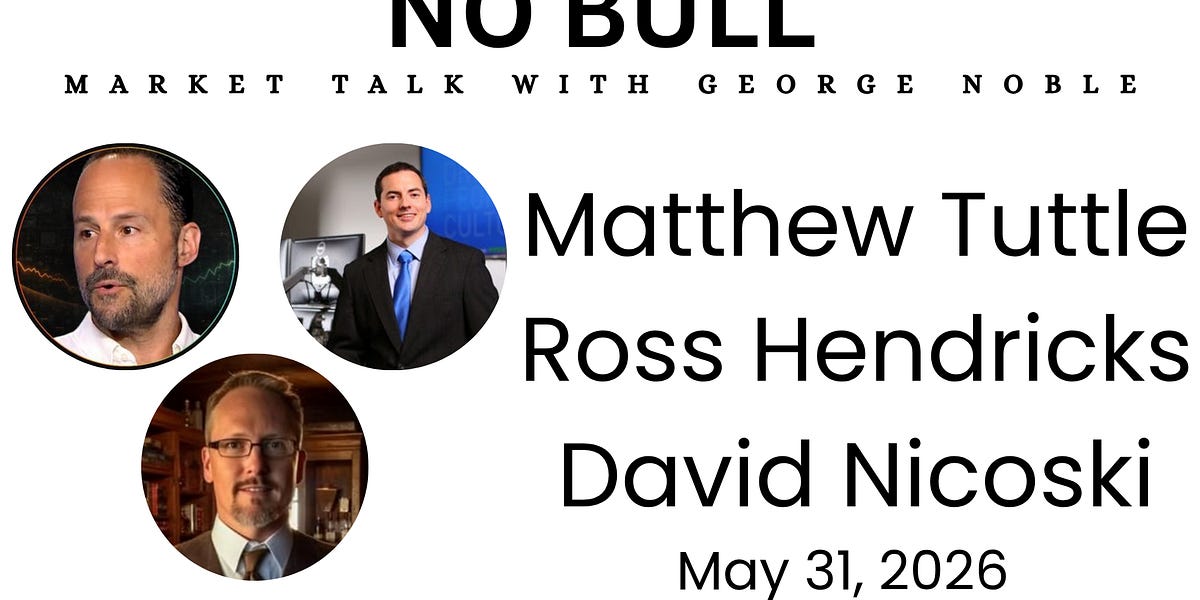
I joined George Noble’s X Spaces on Sunday to talk markets……
The H.E.A.T. (Hedge, Edge, Asymmetry and Theme) Formula is designed to empower investors to spot opportunities, think independently, make smarter (often contrarian) moves, and build real wealth.
The views and opinions expressed herein are those of the Chief Executive Officer and Portfolio Manager for Tuttle Capital Management (TCM) and are subject to change without notice. The data and information provided is derived from sources deemed to be reliable but we cannot guarantee its accuracy. Investing in securities is subject to risk including the possible loss of principal. Trade notifications are for informational purposes only. TCM offers fully transparent ETFs and provides trade information for all actively managed ETFs. TCM's statements are not an endorsement of any company or a recommendation to buy, sell or hold any security. Trade notification files are not provided until full trade execution at the end of a trading day. The time stamp of the email is the time of file upload and not necessarily the exact time of the trades. TCM is not a commodity trading advisor and content provided regarding commodity interests is for informational purposes only and should not be construed as a recommendation. Investment recommendations for any securities or product may be made only after a comprehensive suitability review of the investor’s financial situation.© 2026 Tuttle Capital Management, LLC (TCM). TCM is a SEC-Registered Investment Adviser. All rights reserved.