
I’ve been a trader and investor for 44 years. I left Wall Street long ago—-once I understood that their obsolete advice is designed to profit them, not you.
Today, my firm manages around $5 billion in ETFs, and I don’t answer to anybody. I tell the truth because trying to fool investors doesn’t help them, or me.
In Daily H.E.A.T. , I show you how to Hedge against disaster, find your Edge, exploit Asymmetric opportunities, and ride major Themes before Wall Street catches on.
Monday was Labor Day. The New York Stock Exchange and Nasdaq were closed.
GPT-6 Astra was not. Neither was Grok Bot.
OpenAI released Astra on Thursday. The company says it can use browsers and computer tools to carry out multistep professional work.
Last month, Elon Musk's xAI launched Grok Bot. xAI describes it as a team of always-on agents with their own computers that can work inside apps and websites.
An AI agent is software that can complete a chain of tasks instead of answering one question. These are company claims, not proof that every job can run unattended.
The direction is still hard to miss. AI is moving from a tool that waits for a prompt toward software that accepts a job and keeps going.
The market was taking a holiday. The new labor force was not.
The First Receipt
OpenAI's enterprise data shows what happens when companies move from testing AI to putting it to work.
Its “frontier firms”—the top 10% by monthly usage—now generate 8.3 times as many output tokens per active user as typical firms. That gap was only 2.6 times in January.
An output token is a small piece of text or code produced by a model. OpenAI defines typical firms as those near the middle of its customer base.
As of June, Codex produced 64% of the combined enterprise output tokens from Codex and ChatGPT. Codex is OpenAI's software-development agent.
The heavy users are not merely adding more employees. They are asking each user to hand AI much more work.
The broader economy is still early. A St. Louis Fed analysis estimates that 39.2% of employed U.S. adults used generative AI for work during the prior week.
AI assisted only 6.3% of all work hours, based on respondents' own estimates.
That leaves an unusual setup: the deepest users are accelerating, while most working hours remain untouched.
Then comes the question behind the entire chip trade.
If every AI task becomes cheaper, why would the world need more computing power?
The 1865 Warning
William Stanley Jevons asked a version of that question in 1865.
Britain's steam engines were becoming more fuel-efficient. Many people expected those engines to reduce the country's appetite for coal.
Jevons argued that efficiency changed the economics. Cheaper steam power spread into more factories, ships, railroads, and mines.
Each engine used coal more efficiently, while the economy found many more reasons to run engines.
Economists later called the full version of that rebound the Jevons paradox. It occurs when efficiency lowers resource use per task, but cheaper service creates enough new activity to raise total resource use.
That is the bullish case for AI infrastructure. Total compute demand equals the compute used by each task, multiplied by the number of tasks.
Inference is the work a trained model performs when it answers, writes, codes, or acts. Efficiency lowers the compute needed for each inference task, while lower prices can create many more tasks.
If tasks multiply faster than compute per task falls, total demand rises.
AI agents make that outcome plausible. One request can become research, coding, testing, revisions, and several trips through a model.
OpenAI's usage gap gives the argument an early receipt. The companies furthest along are not using slightly more AI; they are using far more per person.
But Jevons is a warning, not a law. Modern research says the evidence for complete economy-wide “backfire” remains far from conclusive.
Cheaper AI can expand total compute demand. It does not guarantee it.
The Bottleneck Moves Into the Physical World
Software can spread with a copy. Power cannot.
A Department of Energy-backed study estimated that data centers used 4.4% of U.S. power in 2023. It projected that share could reach 6.7% to 12% by 2028.
In June, the Federal Energy Regulatory Commission, or FERC, took a major grid action. It ordered all six regional grid operators to justify or rewrite connection rules for data centers and other large users.
In this setting, a tariff is the grid's rulebook and price schedule—not an import tax.
FERC says it wants faster connections while protecting existing customers from unfair costs. That is a harder problem than “regulation is bad” or “build everything.”
The best case study began beside a nuclear plant in Pennsylvania.
The Deal That Had To Change Its Wiring
Talen Energy Corporation (Nasdaq: TLN) sold an adjacent data-center campus to Amazon.com, Inc. (Nasdaq: AMZN) in 2024.
The original plan expanded the amount of power Amazon could draw beside Talen's Susquehanna nuclear plant. FERC rejected the proposed agreement in November 2024 because the grid operator had not shown that the amended terms were just and reasonable.
The demand did not disappear, so Talen and Amazon changed the structure.
They replaced the disputed setup with a front-of-the-meter power purchase agreement, or PPA. A PPA is a long-term contract to buy power.
Front-of-the-meter means the plant sends its power into the regional grid. The local utility then moves and delivers the power to Amazon.
The revised contract can supply up to 1,920 megawatts through 2042. A megawatt is one million watts of power, and 1,000 megawatts make one gigawatt.
Talen says the transition to the revised agreement occurred in April 2026, while contracted volumes will ramp over time.
That sequence is the real lesson.
The customer stayed. The power stayed. The contract had to change shape before the electrons could move.
The risk is not regulation in the abstract. It is the time, cost, and redesign required to connect enormous new loads without shifting the bill unfairly.
Ten Generations
Then a line from Beijing put the timetable into a different frame.
Stefan Hoops, chief executive of German asset manager DWS Group, shared the most striking comment he heard during a recent trip:
“10 generations suffered because one generation missed the Industrial Revolution.”
That is an anecdote, not a Chinese policy document. It still captures the urgency Hoops heard around artificial intelligence.
The United States is not standing still. FERC is trying to speed connections, and American companies are signing enormous power and equipment orders.
But every year lost in a grid queue is a year when signed demand cannot become revenue.
The AI race is not only about which country builds the best model. It is also about who can turn chips, turbines, transmission lines, and permits into working capacity.
Stock Winners—For Now
NVIDIA Corporation (Nasdaq: NVDA): Nvidia is the clearest listed bet that new AI uses grow faster than efficiency cuts compute per task.
The upside comes from more affordable inference creating more workloads. Risk: custom chips, weaker capital spending, or a true compute glut could break that equation.
GE Vernova Inc. (NYSE: GEV): GE Vernova sells gas turbines, transformers, switchgear, and other equipment needed to expand the power system.
Second-quarter data-center orders exceeded $5 billion year to date, more than double its full-year 2025 total. Risk: a large backlog can take years to become delivered equipment and cash.
Vistra Corp. (NYSE: VST): Vistra operates roughly 44,000 megawatts of generation and has signed long-term data-center-linked power contracts.
Its agreements cover up to 1,200 megawatts for Amazon Web Services and more than 2,600 megawatts for Meta Platforms, Inc. (Nasdaq: META). Risk: plant performance, regulation, and long construction schedules still determine how much contracted demand becomes profit.
Companies With More to Prove
Talen Energy Corporation (Nasdaq: TLN): Talen's Amazon agreement shows that strong demand can survive a policy setback.
The contract can grow to 1,920 megawatts, with full volume expected no later than 2032. Risk: transmission work, grid rules, and delivery timing still sit between the headline agreement and full cash flow.
CoreWeave, Inc. (Nasdaq: CRWV): CoreWeave reported $104 billion of revenue backlog at June 30. Backlog is contracted revenue that has not yet been recognized.
It had 1.5 gigawatts of active power—capacity ready to run equipment—against 3.7 gigawatts under contract. Some contracted power was not yet live.
Second-quarter interest expense was $640 million, versus $128 million of adjusted operating income.
Demand is not the weak point. Risk: the interest clock runs while contracted power waits to become active, billable capacity.
Nebius Group N.V. (Nasdaq: NBIS): Nebius reported that 70% of its second-quarter deals included customer prepayments.
Those payments covered 50% to 60% of the related capital spending. That is better funding than relying only on debt, but Nebius still must connect power and deliver the promised capacity.
What We Are Doing
We are not selling AI infrastructure because models are becoming more efficient. We are also not using Jevons as permission to pay any price.
We separate two questions. Will lower costs create enough new work to expand total compute, and can the physical system deliver that compute profitably?
We favor companies with evidence at the bottleneck: signed chip orders, grid-equipment backlog, long-term PPAs, active power, or customer prepayments.
For compute renters, we separate backlog from active capacity and cash flow. A contract does not pay the interest bill until the service is available.
(If you're not already following our model portfolios, you can learn more here.)
What Changes My Mind
On the Jevons thesis: I get more cautious if two major providers disclose rising AI task volume while the computing resources used to serve that work fall for two consecutive quarters.
That would show efficiency gains outrunning the new demand they create.
On workplace adoption: I get more cautious if the Fed's share of AI-assisted work hours stalls or falls for two consecutive quarterly readings.
I would also want future OpenAI enterprise data to show that the frontier-to-typical usage gap is no longer widening.
On the power bottleneck: I get more cautious if Talen pushes full Amazon volume beyond 2032. I also turn cautious if other signed data-center PPAs slip by more than six months.
I get more constructive when reported connection times fall and new grid rules protect existing customers from costs created by large new loads.
On compute renters: I get more cautious if CoreWeave's gap between contracted and active power widens for two quarters while interest expense rises.
I also get more cautious if Nebius's customer prepayments cover less than 25% of related capital spending for two consecutive quarters.
I get more constructive as active power, operating cash flow, and customer funding catch up with contracted demand.
Investment Implications
Jevons offers a demand framework, not a guarantee. Total compute rises only when new tasks grow faster than compute use per task falls.
OpenAI's heaviest enterprise users are already widening their usage lead, while AI still touches only 6.3% of U.S. work hours.
The physical constraint is moving toward generation, grid equipment, transmission, and connection rules.
Strong demand can still produce a weak investment when financing costs rise or powered capacity arrives late.
The Bottom Line
Today the stock market is closed for Labor Day. GPT-6 Astra and Grok Bot were launched for longer, delegated work that keeps going.
That does not prove each efficiency gain will increase total compute. It does show why counting chips per task misses half the equation.
The other half is how many tasks cheap intelligence creates—and whether the power system can serve them.
The market takes Labor Day off. Software labor does not. Neither does its power bill.
That is the H.E.A.T. Formula at work. The Edge is separating cost per task from total task demand.
The Hedge is watching grid delays and financing before the revenue arrives. The Asymmetry sits in physical bottlenecks that software cannot copy.
The Theme is a new labor force that can work every hour the power stays on.
News vs. Noise
I sat down with S&P Global a few months ago to talk markets and the HEAT Formula…..
Matthew Tuttle, CEO of Tuttle Capital Management, reveals why Trump's policies are set to trigger a MASSIVE surge in gold price and silver price. From debt, tariffs, and Fed policy to the coming shock in precious metals - this is the gold price prediction Wall Street doesn't want you to miss.
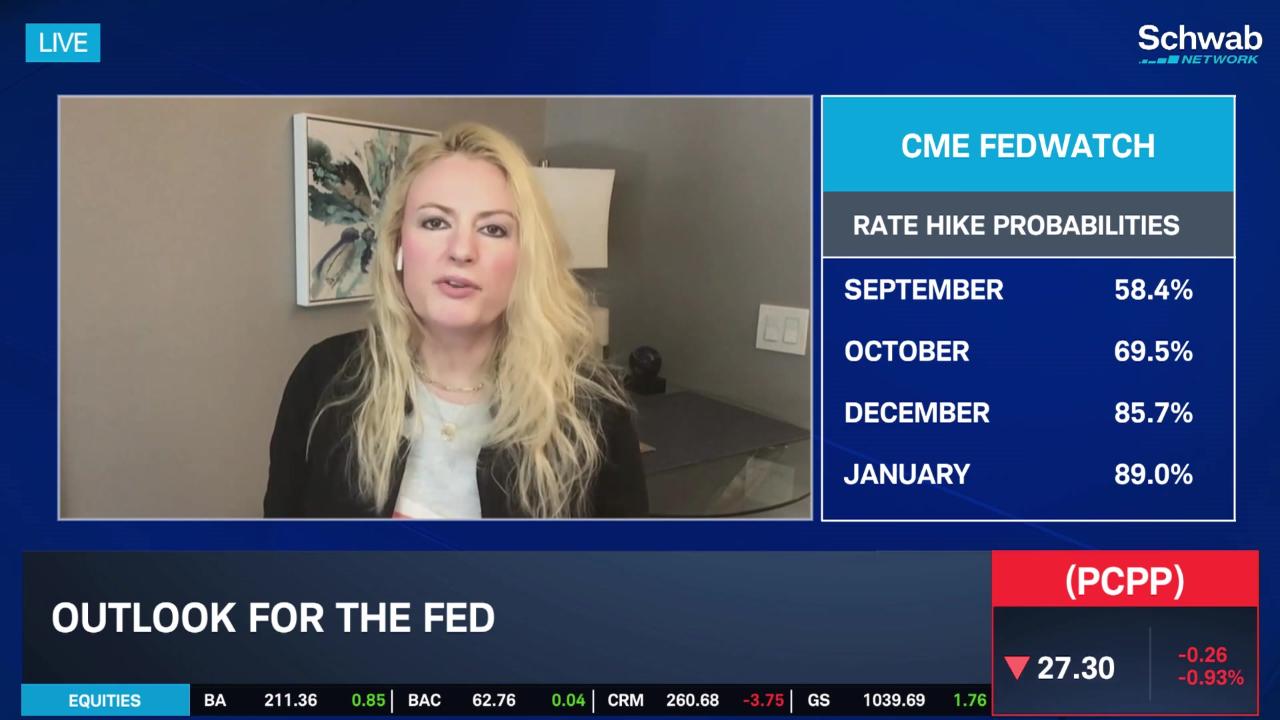
Frances sat down with Schwab on Friday to talk bonds……
The HEAT (Hedge, Edge, Asymmetry and Theme) Formula is designed to empower investors to spot opportunities, think independently, make smarter (often contrarian) moves, and build real wealth.
The views and opinions expressed herein are those of the Chief Executive Officer and Portfolio Manager for Tuttle Capital Management (TCM) and are subject to change without notice. The data and information provided is derived from sources deemed to be reliable but we cannot guarantee its accuracy. Investing in securities is subject to risk including the possible loss of principal. Trade notifications are for informational purposes only. TCM offers fully transparent ETFs and provides trade information for all actively managed ETFs. TCM's statements are not an endorsement of any company or a recommendation to buy, sell or hold any security. Trade notification files are not provided until full trade execution at the end of a trading day. The time stamp of the email is the time of file upload and not necessarily the exact time of the trades. TCM is not a commodity trading advisor and content provided regarding commodity interests is for informational purposes only and should not be construed as a recommendation. Investment recommendations for any securities or product may be made only after a comprehensive suitability review of the investor’s financial situation.© 2026 Tuttle Capital Management, LLC (TCM). TCM is a SEC-Registered Investment Adviser. All rights reserved.