
I’ve been a trader and investor for 44 years. I left Wall Street long ago—-once I understood that their obsolete advice is designed to profit them, not you.
Today, my firm manages around $5 billion in ETFs, and I don’t answer to anybody. I tell the truth because trying to fool investors doesn’t help them, or me.
In Daily H.E.A.T. , I show you how to Hedge against disaster, find your Edge, exploit Asymmetric opportunities, and ride major Themes before Wall Street catches on.
Table of Contents
H.E.A.T.
$195B–$205B New 2026 Alphabet capex guidance | −$5.9B First negative FCF quarter since IPO | $24.8B / +82% Google Cloud revenue, YoY growth | $514B Google Cloud backlog |
Google did not miss the demand story. That is the part investors need to understand first.
The company beat on revenue. Cloud exploded. Search held. Gemini is closing in on a billion users. Backlog grew by more than $50 billion in one quarter. And still the stock sold off.
Why?
Because Google just told Wall Street the AI boom is real enough — and contracted enough — to burn through free cash flow. That is the new test.
TSMC told us the supply chain is spending ahead of the forecast. Google just told us why: demand still exceeds capacity.
Not whether AI demand exists — it does. Google Cloud revenue grew 82% year over year to $24.8 billion. Cloud backlog hit $514 billion, up from roughly $460 billion last quarter. Gemini has 950 million monthly active users. Google's model APIs are now processing about 22 billion tokens per minute, up from 16 billion just one quarter ago. Nearly 90% of the Fortune 100 are using Gemini Enterprise.
The question is different now.
Can the AI giants convert trillion-dollar infrastructure spending into returns before the financing model cracks? |
Alphabet raised its 2026 capex guidance to $195 billion to $205 billion, up from the prior $180 billion to $190 billion range. The company spent $44.9 billion on capex in Q2 alone. Free cash flow swung to negative $5.9 billion — per Alphabet's own non-GAAP reconciliation, operating cash flow of $39.1 billion less capital expenditures of $44.9 billion — the first negative free-cash-flow quarter since the company went public.
And the most important line was not in the income statement. It was the reason for the spending increase.
Google did not say demand weakened. Google did not say AI was experimental. Google did not say it overbuilt. The company said it was accelerating capacity delivery because demand is still bigger than supply.
Google is spending more because it cannot serve all the demand it already sees. |
That is bullish for the physical AI stack. It is not automatically bullish for Google's stock. That distinction is the whole trade.
THE SIMPLE VERSION
Google just showed investors both sides of the AI trade at the same time.
The bull case:
• Cloud revenue is ripping, and AI demand is real.
• Backlog is enormous, and Gemini has massive distribution.
• Tokens are exploding, and Google is supply constrained.
• Customers are signing long-term contracts.
• Google is using third-party capacity as a bridge because its own capacity isn't coming online fast enough.
The bear case:
• Capex is now a $200 billion annual line item.
• Free cash flow went negative.
• 2027 capex is expected to rise again.
• Third-party capacity will pressure cloud margins.
• Depreciation, energy, and data-center operations are about to hit the P&L harder.
• Investors still don't have a clean answer on AI ROI.
That is why the stock fell. Not because the business is weak — because the business is strong enough to require more capital than the market wanted to underwrite.
THE STAT BAR
SIGNAL | WHY IT MATTERS |
$195B–$205B | New 2026 Alphabet capex guidance, up from $180B–$190B. |
−$5.9B | Q2 free cash flow turned negative — first negative FCF quarter since Google's IPO. Per Alphabet's own reconciliation: $39.1B operating cash flow less $44.9B capex. |
$24.8B | Google Cloud revenue, up 82% year over year. |
$514B | Google Cloud backlog, up more than $50B sequentially. |
22B tokens/minute | Google model APIs, up from 16B last quarter. |
950M users | Gemini is nearing the billion-user club. |
THE LINE THAT MATTERS
The market focused on the number: $200 billion. That is understandable — it is enormous. But the important part is the reason.
Google said the capex increase was primarily about accelerating delivery of capacity to meet demand. It also said demand still outpaces investment and that the environment remains supply constrained. The company plans to use third-party capacity in Q3 as a bridge while internal capacity comes online, and analysts flagged that this should pressure cloud margins.
That tells you three things: the AI demand signal is real; capacity is still the bottleneck; and the economics are moving from the model layer to the infrastructure layer.
This is not a software-company problem anymore. This is a power, chips, servers, memory, networking, cooling, financing, and depreciation problem. Google just turned the AI trade into an industrial capacity trade.
THE BIGGEST MISREAD
The lazy bear case says: "Google is spending too much. AI is a bubble." Maybe. But that is not what the quarter says.
The quarter says Google is spending too much because customers are asking for more capacity than it can deliver. That is a very different problem.
A bad capex problem is when you build capacity nobody wants. A good capex problem is when you have customers lined up before the capacity is built, and you still cannot build fast enough. Google's backlog says this is closer to the second problem.
The issue is not demand. The issue is return. In 2024 and 2025, investors rewarded any company that could say “AI capex.” In 2026, they want to know whether that capex turns into revenue, margin, and cash flow before the debt and depreciation show up.
Google gave a partial answer. Cloud revenue is exploding. Cloud operating income more than tripled. Cloud margin rose to 35.6%, up from 20.7% a year earlier — real operating leverage. But free cash flow still went negative. That is the tension.
THE TPU SIGNAL
There was another detail investors should not ignore. Google began recognizing revenue from TPU system sales delivered to customer data centers for the first time in Q2, according to earnings-call coverage.
That matters. Google is no longer just buying AI infrastructure for itself. It is starting to sell pieces of its AI infrastructure stack to customers — a direct challenge to the Nvidia-only version of the AI trade. Not because Nvidia is weak. Because hyperscalers are now trying to turn their internal silicon into external products.
Old map: Nvidia sells accelerators; hyperscalers buy them. New map: hyperscalers still buy Nvidia, but they're also turning internal silicon into customer-facing infrastructure. |
That is why Google's quarter is so important. The AI trade is not just “more Nvidia.” It is more compute architectures. That is bullish for total AI infrastructure. It is more complicated for Nvidia's multiple.
THE THIRD-PARTY CAPACITY TELL
Google using third-party capacity as a bridge is the most important read-through for neoclouds and AI data-center landlords.
If Google, one of the richest and most technically capable companies in history, still has to rent capacity while it waits for its own infrastructure, that tells you time-to-power is now worth paying for.
The hyperscalers can build. They just cannot always build fast enough. |
That supports operators with real power, real capacity, real contracts, and real deployment capability. It does not support every GPU rental story. A contracted AI infrastructure operator with power, financing, and customers can benefit from Google's capacity shortage. A speculative GPU landlord with no durable customer base is still just renting depreciating hardware into a volatile market.
WINNERS & LOSERS
COMPANY / SECTOR | VERDICT | WHY IT MATTERS | RISK |
TSMC, ASML, AMAT, LRCX, KLAC, Tokyo Electron, ASMI, SCREEN Holdings | WINNER | Google's capex raise flows straight into wafers, lithography, deposition, etch, and advanced packaging — the physical layer under every AI headline. | Semicap order books can lag capex announcements by 2–3 quarters. |
Nvidia | WINNER (with caveat) | No company spends $200B on AI infrastructure because it thinks accelerator demand is peaking. Nvidia still owns the default compute path. | Google's TPU sales and hyperscaler custom silicon widen the share going to non-Nvidia compute over time. |
Broadcom, Marvell | WINNER | Google's TPU revenue recognition confirms custom silicon is becoming a product line, not internal plumbing — these are the ASIC/networking enablers. | Concentration risk if custom-silicon roadmaps consolidate around fewer design partners. |
Micron, SK Hynix, Samsung | WINNER | AI servers do not run without memory. Rising token volume and expanding context windows keep HBM/memory demand structurally intact. | Allocation and pricing power vary sharply by supplier; upside is not equal across the three. |
Arista, Coherent, Lumentum, Credo, Amphenol, Fabrinet | WINNER | Every accelerating buildout has to scale the whole cluster — switches, optics, retimers, cabling, interconnect. | Valuations have run; timing and multiple compression are the live risks. |
CoreWeave, Nebius, IREN, Applied Digital, Hut 8, TeraWulf, Cipher | WINNER (conditional) | Google's admitted use of third-party capacity validates the neocloud thesis — even hyperscalers need bridge capacity when internal builds lag. | Only applies to operators with real contracts, power, and deployment capability. |
Eaton, Vertiv, GE Vernova, Quanta Services, Hubbell, nVent, Powell, Comfort Systems, Modine | WINNER | A $200B capex budget is a power-delivery and cooling problem as much as a compute problem. | Grid interconnect and permitting timelines can slow revenue recognition. |
Google Cloud (segment) | SEGMENT WINNER / PARENT-STOCK DEBATE | Revenue +82% to $24.8B; backlog at $514B with over half expected to convert within 24 months — contracted demand, not theoretical. | Third-party capacity leasing could pressure segment margins in Q3; parent-company FCF and capex intensity can overwhelm segment momentum near term. |
Datadog, Dynatrace, Cloudflare, Palo Alto Networks, Zscaler, Okta, SailPoint, Snowflake, MongoDB, Elastic, Palantir | WINNER | Rising AI usage plus rising AI cost creates demand for tools that monitor, govern, and control AI spend. | Crowded category; differentiation among names varies widely. |
Alphabet free-cash-flow bulls | LOSER | The thesis that Google could fund AI entirely from operating cash flow without visible strain broke this quarter. | If FCF stabilizes next quarter, this reverses quickly — confirm the actual figure first. |
Microsoft, Amazon, Meta, Oracle (margin discipline) | PRESSURE | Google flagged that third-party capacity and rising data-center opex could pressure margins — the same question applies across the group. | Company-specific capex discipline could differentiate outcomes next earnings cycle. |
“AI capex is over” short thesis | LOSER | Google raised guidance and said demand still exceeds investment — the opposite of a spending slowdown. | A genuine demand air-pocket would still validate the short thesis eventually. |
Nvidia-only simplification | LOSER (thesis) | TPU system revenue, Trainium, Maia, and MTIA all point toward hyperscalers wanting control over cost-per-token. | Nvidia's near-term volume lead isn't in question; this is a multi-year share-of-wallet argument. |
SMCI, Dell, HPE (server assemblers) | MARGIN PRESSURE / VOLUME WINNER | More capex helps revenue but not necessarily margin if upstream suppliers hold pricing power. | Differentiated services or financing structures could offset commodity assembly economics. |
Debt-funded AI infrastructure narratives | LOSER (relative) | If Google — one of the strongest balance sheets on earth — draws scrutiny on AI capex funding, weaker-balance-sheet operators face a higher bar. | Credit market appetite for AI infrastructure debt is the swing factor to watch. |
Model-lab-only valuation marks | LOSER (thesis) | Distribution, infrastructure, silicon, and enterprise contracts are proving to matter as much as the model itself. | Frontier model breakthroughs can still re-rate a lab quickly. |
Search complacency | WATCH | Search grew 17% and held, but AI-driven changes to query and click behavior remain an open multi-year question. | Google is defending and rebuilding the franchise at the same time — execution risk either way. |
POSITIONING
Overweight the parts of the AI trade where demand is contracted and economics are provable: semicap and advanced packaging, HBM and memory, power and cooling infrastructure, networking and optics, custom-silicon enablers, and neocloud capacity with real contracts and power. Underweight uncontracted GPU rental, low-margin rack assembly, debt-heavy AI infrastructure, and pure model-lab valuation stories. Google did not kill the AI trade — it made it more selective. See Winners & Losers above for names.
PRESSURE POINTS
PRESSURE POINT | WHAT TO WATCH | TIME HORIZON |
Microsoft, Meta, Amazon capex | Google is the first witness. If the others raise capex too, the supplier trade gets another leg. If they hold discipline, Google looks like the outlier. | Next earnings cycle |
Third-party capacity commentary | Watch for mentions of outside compute, cloud leasing, or bridge capacity from other hyperscalers — more admissions strengthen the neocloud trade. | Ongoing |
Google Cloud margins | Cloud margin improved sharply this quarter, but third-party capacity could pressure Q3. Margin resilience is the AI-ROI tell. | Q3 2026 |
TPU revenue disclosure | If Google keeps selling TPU systems externally, custom silicon becomes a real revenue line, not just an internal cost save. | Ongoing |
Gemini model cadence | Watch whether Gemini 4 actually closes the gap with OpenAI and Anthropic at the frontier — that determines whether capex looks strategic or defensive. | 2026–2027 |
Free cash flow trend | One negative quarter is manageable. A negative trend alongside rising 2027 capex is a different story. | 2026–2027 |
Credit markets | Google can finance almost anything, but that doesn't mean the market will love it. Watch spreads and debt issuance appetite across the hyperscaler complex. | Ongoing |
CREDIBILITY FIREWALL
SOURCED / REPORTED | MODELED / INFERRED | EDITORIAL VIEW |
Alphabet raised 2026 capex guidance to $195B–$205B (Reuters). | — | Google is telling investors AI demand is still bigger than capacity. |
Google Cloud revenue grew 82% to $24.8B (Reuters). | Backlog-to-revenue conversion pace implies more than half of the $514B backlog converts within 24 months (company/analyst modeling). | Cloud is the first clear place AI capex is converting into revenue. |
Alphabet's Q2 2026 earnings release (SEC Form 8-K, Exhibit 99.1) reports free cash flow of −$5.9B ($39.1B operating cash flow less $44.9B capex), confirmed directly against the filing. | — | The AI trade is now a financing and ROI question, not just a demand question. |
Model APIs process ~22B tokens/minute; Gemini has 950M MAU (Investing.com, Business Insider). | — | Usage is scaling fast enough to justify continued infrastructure spend. |
Google began recognizing revenue from TPU system sales to customer data centers (Reuters). | Scale of external TPU revenue is not yet disclosed — treat as an emerging, not proven, revenue line. | Custom silicon is moving from internal efficiency tool to external product. |
Google plans to use third-party cloud capacity as a bridge in Q3 (Business Insider, MarketWatch). | Analysts flag this as a likely near-term cloud margin headwind, not yet reflected in guidance. | Neoclouds benefit if hyperscalers can't build fast enough — but only contracted, powered operators earn the credit. |
KEY TAKEAWAYS
1. Google did not miss the demand story — it spent too much for the market's comfort. The quarter was strong; the stock fell because capex and free cash flow (confirmed at −$5.9B against Alphabet's own SEC filing) became the whole story.
2. The AI demand signal is real. Cloud revenue grew 82%, backlog reached $514B, Gemini usage is huge, and token volume is exploding.
3. Capacity is still the bottleneck. Google raised capex because it needs capacity faster, not because demand weakened.
4. The supplier trade is intact. TSMC, ASML, semicap, HBM, packaging, networking, power, and cooling all benefit from a $200B capex program.
5. The stock-market question has changed. Investors no longer ask “is AI real?” — they ask “who earns the return on AI capex?”
6. Google is becoming an AI infrastructure merchant. TPU system revenue signals hyperscaler custom silicon is becoming an external business, not just internal plumbing.
7. Nvidia still wins, but the trade is more complex. More AI capacity helps Nvidia; more custom silicon makes the long-term margin map less simple.
8. Neoclouds get validation, not a blank check. Third-party capacity is useful because hyperscalers need a bridge — but only operators with real power, contracts, and deployment ability deserve credit.
9. The AI trade is moving from capex to ROI. Google proved the spending continues. Now the market wants to see the cash flows.
The longest-running theft in American history?
Porter Stansberry's argument: when new money is printed, the dollars you already hold
quietly lose purchasing power, a "theft" you never see on any statement. Whether or not
you agree, the Porter & Company Porter Portfolio Index ETF (PCPP) was built for
investors who'd rather hold a diversified mix than sit in cash. It tracks a rules-based index
split roughly four ways: P&C insurers, capital-efficient equities, hard assets, and
short-term fixed income.
Investing involves risk including possible loss of principal.
Read the prospectus at porterandcofunds.com.
Consider the fund's investment objectives, risks, charges, and expenses carefully before
investing. This and other information are in the prospectus at PorterandCoFunds.com or (833)759-6110; read it carefully before investing. Investing involves risk, including possible loss of principal. PCPP is new and non-diversified. Distributed by Foreside Fund Services, LLC.
News vs. Noise: What’s Moving Markets Today
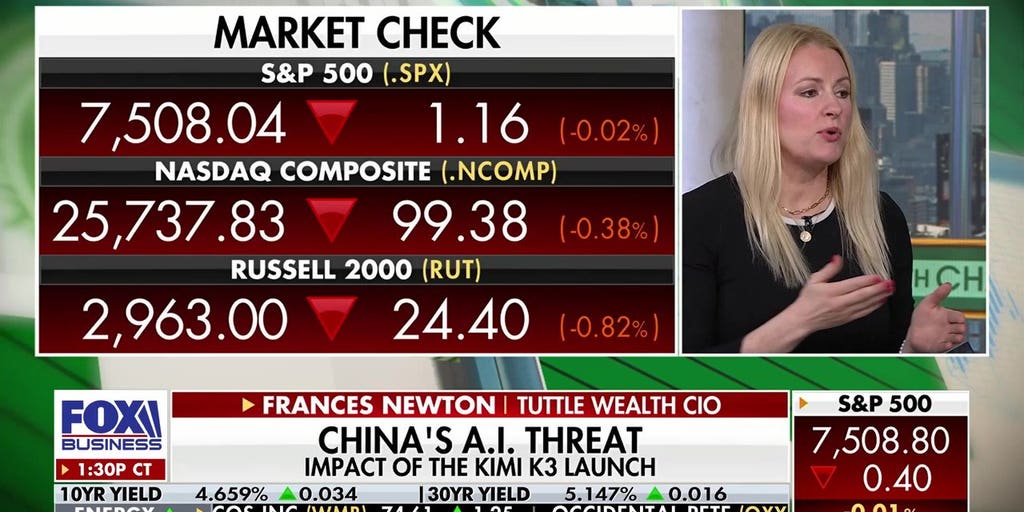
The market gave back a bit of Tuesday’s gains yesterday and is somewhat red this morning. However, most of this morning’s sell off appears to be Mag 7 related.
Of course some more negative Iran headlines are pushing oil prices back towards 90…..

That’s bringing rates back up…..

We still have a ways to go, but I think a 10 year at 5% or over would be a big problem for equities.
Meanwhile, we have seen a few undercuts of key lows in SMH and rallies back above…..

The memory and photonics names are clearly in the green this morning. I’m not seeing anything that would dissuade me from thinking the momentum stocks found a bottom on Tuesday. However, rates and oil prices could change that view very quickly.
The news. The market now has two oil chokepoints and one Fed problem. Brent hit $96 as Houthi attacks pushed tankers away from Bab el-Mandeb while Hormuz was already impaired. Reuters says simultaneous disruption would threaten routes carrying more than one-quarter of the world’s oil and gas. Short Treasury yields reached a 17-month high, traders priced 42 basis points of Fed hikes this year, and a September move is now fully priced. The 30-year Treasury has spent 11 straight sessions above 5%, its longest such stretch since 2007. That is the Warsh regime. No forward-guidance blanket. Oil moves. Inflation risk moves. The front end decides whether every meeting is live. (Reuters — markets, oil and Fed pricing, Reuters — the two-strait risk, MarketWatch — the 30-year Treasury milestone)
The noise. The noise is that Alphabet’s results settled the AI debate. They did not. Google Cloud revenue rose 82% to $24.8 billion, showing that demand is real. Alphabet then raised 2026 capital spending to $195 billion–$205 billion, reported negative free cash flow of $5.9 billion for the quarter, and watched its stock fall after hours. This is no longer an AI-demand problem. It is an AI-return problem. Memory suppliers, chipmakers, optics companies, and infrastructure vendors get paid early. Hyperscalers write the checks and wait for the operating leverage. The memory supercycle can remain intact while the companies financing it face lower free cash flow, more scrutiny, and less room for error. (Reuters — Alphabet earnings and capex, Reuters — Asian chipmakers and the return question)
Takeaways.
Watch Hormuz and Bab el-Mandeb together. The energy risk is now correlated.
September is fully live. Follow the 2-year, not yesterday’s dots.
A 30-year Treasury above 5% for 11 sessions is duration risk, not safety.
Alphabet confirmed AI demand. It did not prove AI returns.
Favor memory, networking, optics, storage, power, and equipment selectively.
Scrutinize the companies funding the buildout. Cloud growth and shrinking free cash flow can coexist.
Do not buy a capex story without asking who captures the economics.
ETF News
A Stock I’m Watching

The past couple of days I’ve gotten more interested in the photonics names, China, and gold miners. The nuclear names are also starting to look interesting again.
In Case You Missed It
Great conversation on wide ranging topics with Kenny Polcari…

The H.E.A.T. (Hedge, Edge, Asymmetry and Theme) Formula is designed to empower investors to spot opportunities, think independently, make smarter (often contrarian) moves, and build real wealth.
The views and opinions expressed herein are those of the Chief Executive Officer and Portfolio Manager for Tuttle Capital Management (TCM) and are subject to change without notice. The data and information provided is derived from sources deemed to be reliable but we cannot guarantee its accuracy. Investing in securities is subject to risk including the possible loss of principal. Trade notifications are for informational purposes only. TCM offers fully transparent ETFs and provides trade information for all actively managed ETFs. TCM's statements are not an endorsement of any company or a recommendation to buy, sell or hold any security. Trade notification files are not provided until full trade execution at the end of a trading day. The time stamp of the email is the time of file upload and not necessarily the exact time of the trades. TCM is not a commodity trading advisor and content provided regarding commodity interests is for informational purposes only and should not be construed as a recommendation. Investment recommendations for any securities or product may be made only after a comprehensive suitability review of the investor’s financial situation.© 2026 Tuttle Capital Management, LLC (TCM). TCM is a SEC-Registered Investment Adviser. All rights reserved.