
I’ve been a trader and investor for 44 years. I left Wall Street long ago—-once I understood that their obsolete advice is designed to profit them, not you.
Today, my firm manages around $5 billion in ETFs, and I don’t answer to anybody. I tell the truth because trying to fool investors doesn’t help them, or me.
In Daily H.E.A.T. , I show you how to Hedge against disaster, find your Edge, exploit Asymmetric opportunities, and ride major Themes before Wall Street catches on.
Table of Contents
H.E.A.T.
Every great structural buildout has a moment where the narrative jumps the supply chain.
AI did it in eighteen months. First the consensus trade was the model layer — Microsoft, Google, OpenAI. Then it became compute — Nvidia. Then memory — SK Hynix and Micron. Then interconnects, then power. Each chokepoint compounded faster than the last because each one was harder to build and easier to count.
Humanoid robotics is about to run the same playbook in fast-forward.
The consensus trade today is platforms. Tesla Optimus. Figure. Agility. Apptronik. Unitree. Every fund manager with a deck has a slide on the labor-replacement TAM — Morgan Stanley's bull case is $24 trillion by 2065, with shorter-dated estimates from Goldman, Citi, and BofA stacking up below it. The platform companies will be huge.
They will also not be where the early money is made.
A bill of materials breakdown for the humanoid supply chain — published last week by McKinsey, but consistent with what every component buyer in the industry has been quietly saying for two years — identifies four parts as critical, supply-constrained, and concentrated in a handful of mostly Asian suppliers. Gearboxes. Roller screws. Magnets. Linear guides. Elon Musk has publicly conceded that magnet supply is gating Optimus production. SKF cannot make planetary roller screws fast enough. Harmonic Drive's order book is backed up past 2027.
A humanoid robot is essentially a stack of precision joints. The wrist is where cheap robots go to die — backlash, jitter, magnet failure, screw fatigue. Without these four parts, you don't ship robots. With them, you set the price.
This is the opportunity. Not the robot. The wrist.
THE FORCING FUNCTION
The mechanism that makes this trade investable — before robots are real at scale — is straightforward arithmetic.
Tesla wants 1 million Optimus units by 2030. Figure has signed BMW. Apptronik has signed Mercedes. Each of these platforms is publicly committed to volumes that, in aggregate, exceed current global capacity for harmonic drives, planetary roller screws, and rare earth magnets — combined.
Component lead times run three to five years. New capacity for precision gearboxes requires custom machine tools, specialized labor, and qualification cycles that cannot be compressed. The math has only one solution: platforms must pre-buy capacity now, in long-term supply agreements, to have any chance of hitting their own targets.
That dynamic — guaranteed volume plus pricing power for the suppliers who can actually deliver — is what re-rates a boring industrial multiple into a thematic growth multiple. It happened to ASML in 2017. It happened to Vertiv in 2023. It happens before the end product is mainstream, not after. By the time Optimus is on factory floors at scale, the supplier multiples have already moved.
THE NUMBERS
$24T Humanoid TAM by 2065 (bull case) Morgan Stanley | 90% China share of NdFeB magnet refining USGS / IEA | 1M+ Optimus units Tesla targets by 2030 Tesla | 5 yr Typical lead time, harmonic drive capacity McKinsey |
THE FOUR CHOKEPOINTS
Four components — confirmed in McKinsey's recent supply chain work and in our own conversations with motion-control buyers — show the widest gap between humanoid demand and Western manufacturing capacity. Each is precision-intensive, capital-heavy, and dominated by a small number of incumbents — most of them Japanese, Swedish, German, or Chinese.
01 — HARMONIC AND STRAIN-WAVE DRIVES Failure mode: Without near-zero backlash, the robot can't perform fine motor control. Period. The compact, ultra-precise gearboxes that go in robot wrists, knees, and elbows. A single Tesla Optimus uses an estimated 14 to 28 of these. Incumbents: Harmonic Drive Systems (6324.T) holds roughly 80 percent global share. Nabtesco (6268.T) and China's Leaderdrive (688017.SS) round out the top three. Capacity expansion runs on a five-year horizon — and existing order books are already extending past 2027. Western alternative: Timken (TKR) acquired Cone Drive specifically to enter this market. Schaeffler AG (SHA0) is investing aggressively in harmonic drive production at its Erlangen and Bühl facilities. |
02 — PLANETARY ROLLER SCREWS Failure mode: Without cycle-life under load, legs fail in the field — not the lab. Service economics collapse first, customers second. These convert rotation to linear motion under heavy load — used in legs, hips, and lifting joints. They are arguably the hardest single component in the entire humanoid BOM to manufacture at precision and scale. Incumbent: SKF (SKF-B.ST) is the dominant Western supplier and has publicly stated that humanoid demand alone could absorb its entire planetary roller screw capacity. The company is building a dedicated facility in France to expand output. Western alternatives: Schaeffler via its Ewellix subsidiary (SHA0), Moog (MOG.A) — already supplying actuators to Apptronik — and Parker-Hannifin (PH), which has the broadest motion control portfolio in North America. |
03 — PERMANENT MAGNETS (NDFEB) Failure mode: Without NdFeB supply, motors don't ship. No motors, no robots. No exceptions. Neodymium-iron-boron rare earth magnets are the engine of every humanoid motor. China controls roughly 90 percent of global processing and refining capacity. On the record: "Magnet supply has been a constraint on Optimus," — Elon Musk. When the most aggressive humanoid platform CEO publicly names a single component as his bottleneck, that is the entire investment thesis stated in seven words. The geopolitical reality: In April 2025 China imposed export controls on seven heavy rare earths used in high-performance magnets. Western humanoid programs cannot scale on Chinese supply alone — and there is essentially no alternative pipeline operating at meaningful volume today. Western alternatives: MP Materials (MP) — the only fully integrated rare earth and magnet producer in the United States, with magnet production at Independence, Texas. USA Rare Earth (USAR), Neo Performance Materials (NEO.TO), and Mkango Resources (MKA) are earlier-stage but strategically positioned. |
04 — ROBOTICS-GRADE LINEAR GUIDES Failure mode: Without micron-tolerance rails, the robot jitters and binds. Then the warranty service costs eat the margin. Precision rails that allow smooth, controlled linear movement. Tolerances measured in microns. Used throughout the humanoid skeleton — particularly in torso and arm assemblies. Incumbents: The market is a near-total triopoly: Bosch Rexroth (private, part of Robert Bosch GmbH), Hiwin (2049.TW), and THK (6481.T). Combined share exceeds 75 percent globally. The constraint: Hiwin and THK are publicly traded and the most direct ways to play this category. Both have humanoid-specific product lines already shipping. Neither has Western alternatives at meaningful scale. |
CONFIRMED VS. DIRECTIONAL
Humanoid robotics is in the noisy phase of its cycle — every demo video looks like a breakthrough, every TAM estimate carries assumptions stacked five layers deep. We separate what is verified from what is plausible but unconfirmed.
CONFIRMED | DIRECTIONAL |
Tesla has Optimus prototypes in operation; Musk has publicly cited magnet supply as a production constraint. | Tesla's stated 1M-unit-by-2030 target depends on a magnet supply chain that does not yet exist at that scale. |
China imposed rare earth export controls in April 2025 covering seven heavy rare earths. | The full impact on Western humanoid programs is unknown — workarounds (samarium-cobalt, ferrite) trade performance for security. |
SKF has publicly stated humanoid demand could absorb its full planetary roller screw capacity. | Whether SKF's France expansion comes online in time to capture the first commercial wave is an open question. |
Harmonic Drive Systems holds dominant share in strain-wave gearboxes and has multi-year order backlogs. | Whether Western alternatives (Timken, Schaeffler) can meaningfully gain share before 2028 is unproven. |
WINNERS — TIERED BY CONVICTION
The bottleneck plays divide cleanly into three tiers based on revenue concentration, competitive moat, and time to humanoid revenue.
TIER 1 — DIRECT CHOKEPOINT EXPOSURE
COMPANY | TICKER | WHY IT MATTERS |
Harmonic Drive Systems | 6324.T | Roughly 80% global share in strain-wave gearboxes. Multi-year backlog. Most direct humanoid pure-play on any exchange. |
SKF | Dominant Western planetary roller screw supplier. Publicly stated humanoid demand could absorb full capacity. | |
MP Materials | MP | Only integrated U.S. rare earth and magnet producer. DoD and Apple offtake agreements. Direct beneficiary of every Western humanoid program that needs to escape Chinese supply. |
Hiwin Technologies | One of three global incumbents in robotics-grade linear guides. Already shipping humanoid-specific product. | |
THK | 6481.T | The third leg of the linear guide triopoly. Broader industrial base provides revenue cushion. |
TIER 2 — DIVERSIFIED INDUSTRIAL WITH MATERIAL HUMANOID OPTIONALITY
COMPANY | TICKER | WHY IT MATTERS |
Schaeffler AG | SHA0 | Plays in three of four chokepoints — harmonic drives, planetary roller screws (Ewellix), and bearings. Largest exposure outside Japan. |
Nabtesco | 6268.T | Number two player in precision reduction gears globally. Leveraged to industrial robotics broadly, humanoid is upside. |
Parker-Hannifin | PH | Broadest motion control portfolio in North America. Aerospace/defense base provides downside support; humanoid is optionality. |
Moog | MOG.A | Already supplying actuators to Apptronik. Smaller and more leveraged to humanoid wins than Parker. |
Timken | TKR | Acquired Cone Drive specifically to enter strain-wave gearboxes. Industrial bearings cushion provides downside. |
TIER 3 — EARLIER-STAGE, HIGHER BETA
COMPANY | TICKER | WHY IT MATTERS |
USA Rare Earth | USAR | Round Top deposit plus magnet production facility in Stillwater, Oklahoma. Earlier-stage than MP but pure rare earth play. |
Neo Performance Materials | Operating magnet production at Narva, Estonia. Only producer of sintered NdFeB magnets in Europe at commercial scale. | |
Mkango Resources | MKA | Recycling-focused magnet supply chain via UK and Germany. Smallest of the rare earth names but levered to European policy support. |
Leaderdrive | China's domestic answer to Harmonic Drive. Direct exposure but carries China-specific regulatory and currency risk. |
PRESSURE POINTS
Companies whose risk is about timing or margin compression — not business failure — as the bottleneck dynamics play out.
RISK VECTOR | WHAT TO WATCH |
Pure-play humanoid platforms | Privately funded humanoid companies (Figure, 1X, Apptronik) face component allocation risk — the ones who locked in supply early win, the ones who didn't may slip 18 to 24 months. This is a known unknown for any platform-tier exposure. |
Tesla (TSLA) | Optimus economics depend on vertical integration of magnets and actuators that Tesla has not yet demonstrated at scale. The 1M-unit target is an Elon stretch goal. Stock is not a humanoid pure-play and shouldn't be valued like one. |
Chinese magnet producers | JL Mag, Zhongke Sanhuan and others dominate volume but carry growing geopolitical headline risk. Western OEMs have explicit mandates to diversify away. |
Generic motion control names | Companies marketing themselves as "robotics exposure" without specific humanoid component wins (Rockwell, Emerson) will see less of the multiple expansion. Solid businesses, but not the trade. |
THE BEAR CASE — HONESTLY
WHAT WOULD BREAK THIS THESIS Three things could derail the bottleneck trade and we owe readers an honest accounting: 1. Humanoid adoption disappoints. If Optimus, Figure, and Apptronik fail to demonstrate commercial unit economics by 2027, the entire TAM collapses and component suppliers re-rate as boring industrial stocks again. The history of robotics is littered with TAMs that arrived a decade later than promised. 2. China lifts export controls. If Beijing decides rare earth weaponization costs more than it gains — entirely possible — the urgency around Western magnet capacity dissipates. MP Materials and USA Rare Earth would still have business; their multiples would compress materially. 3. Component innovation routes around the bottleneck. Direct-drive motors, ferrite-magnet alternatives, or novel actuator architectures could shrink the role of the four chokepoints. Tesla has hinted at vertical integration of multiple components — if successful, the merchant-supplier thesis weakens. We think these risks are real but mispriced. The base rate for major industrial buildouts is that constraints take longer to relieve than markets expect, and that re-shoring efforts driven by national security tend to overshoot rather than undershoot. The asymmetry favors owning the chokepoints. |
TACTICAL RISKS FOR SIZING AND PATIENCE Timeline slip. If commercial humanoid deployment slips 24 months, the bottleneck thesis still holds — but multiple compression on the supplier names is real before the next leg up. Position size accordingly. Capacity over-builds the cycle. If SKF's France facility ramps faster than expected, or if Harmonic Drive announces step-function capacity expansion, the scarcity premium compresses even as revenue grows. Good for the businesses, less good for the multiple. Thematic rotation. Markets cycle in and out of "future tech" themes on macro signals that have nothing to do with humanoid fundamentals. Expect 20 to 30 percent drawdowns in even the best names along the way. This is a multi-year hold, not a quarter trade. |
FIVE TAKEAWAYS
1. The humanoid platform trade is the consensus. The component trade is the contrarian one. History says the latter pays better in the early innings of any structural buildout.
2. Four chokepoints — strain-wave gearboxes, planetary roller screws, rare earth magnets, and linear guides — gate the entire industry. A robot needs all four to function; supply for all four is constrained.
3. Tier 1 names with the most direct exposure are Harmonic Drive Systems (6324.T), SKF (SKF-B.ST), MP Materials (MP), Hiwin (2049.TW), and THK (6481.T). These are where the cleanest expression of the thesis lives.
4. Magnet supply is the single highest-conviction sub-thesis. China's 90 percent processing share plus April 2025 export controls plus Musk's public concession on Optimus equals a Western magnet capacity buildout that is no longer optional.
5. Watch Q4 2026 earnings calls for capacity expansion announcements at SKF, Harmonic Drive, and MP. The signal that the bottleneck is binding is when these companies start raising capex guidance materially. That is also when the multiples re-rate.
Space Exposure Designed For Potential Weekly Payouts
The space economy is no longer just a government program — it’s becoming part of a global industry that is gradually advancing.
But why view long-term growth as the only potential path forward?
SPCI seeks to offer approximately 100% concentrated exposure to the space industry while striving to generate weekly income through a disciplined put credit spread options strategy.
Gain exposure to the “final frontier” and a potential weekly distribution while you wait for the theme to play out.
Discover SPCI.
Distributor: Foreside Fund Services | Investing involves risk including possible loss of principle.
News vs. Noise: What’s Moving Markets Today
I shared my views yesterday with the Schwab Network…..
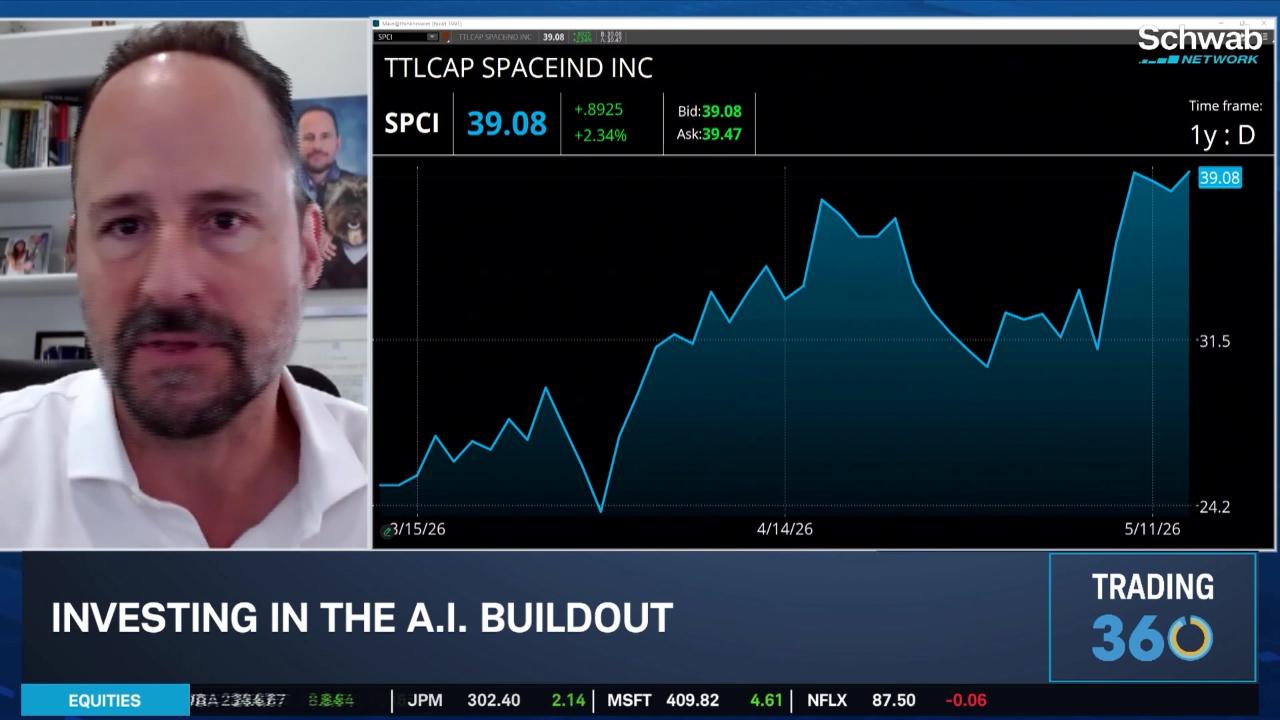
and when I was walking the dog….
I’ve been talking about higher oil prices and higher rates for a while, including on Schwab yesterday. This morning we are seeing the impact.
Oil is back over $100 and rates are moving higher around the world. Two takeaways from this….
Don’t own bonds. I’ve said it before, I’ll say it again, at these interest rate levels bonds are a crappy trade.
Have some energy stocks, ie. don’t automatically assume the Iran war is going to end tomorrow and oil is going back to $60 overnight.
Meanwhile, keep an eye on this. Maybe priced in, but if it’s not you could see crypto rip at some point…….

What Iran Tells Us About UFO Disclosure
When governments confront unknown threats in their airspace, defense budgets surge
and the same aerospace and surveillance companies move hardest. On March 2nd,
Northrop jumped 6% and Lockheed 3.3% on the Iran news — and President Trump has
since ordered the formal release of government UAP files, with the Pentagon confirming
compliance. So if a conventional conflict can move these stocks this fast, what happens
when the bigger story breaks?
See the UFOD holdings: [thetruthisoutthereufod.com
ETF News

A Stock I’m Watching

We added this to MEMY the other day so patting myself on the back on this one. Pulling back today along with everything else so could be a decent dip buy assuming today’s selloff gets bought right back up next week.
In Case You Missed It
Great talk on with the Acquirers Podcast on markets, value investing, inverse Cramer, and Michael Gayed joins me to talk about taking income from your portfolio and how to get more than 4%……
The H.E.A.T. (Hedge, Edge, Asymmetry and Theme) Formula is designed to empower investors to spot opportunities, think independently, make smarter (often contrarian) moves, and build real wealth.
The views and opinions expressed herein are those of the Chief Executive Officer and Portfolio Manager for Tuttle Capital Management (TCM) and are subject to change without notice. The data and information provided is derived from sources deemed to be reliable but we cannot guarantee its accuracy. Investing in securities is subject to risk including the possible loss of principal. Trade notifications are for informational purposes only. TCM offers fully transparent ETFs and provides trade information for all actively managed ETFs. TCM's statements are not an endorsement of any company or a recommendation to buy, sell or hold any security. Trade notification files are not provided until full trade execution at the end of a trading day. The time stamp of the email is the time of file upload and not necessarily the exact time of the trades. TCM is not a commodity trading advisor and content provided regarding commodity interests is for informational purposes only and should not be construed as a recommendation. Investment recommendations for any securities or product may be made only after a comprehensive suitability review of the investor’s financial situation.© 2026 Tuttle Capital Management, LLC (TCM). TCM is a SEC-Registered Investment Adviser. All rights reserved.