
I’ve been a trader and investor for 44 years. I left Wall Street long ago—-once I understood that their obsolete advice is designed to profit them, not you.
Today, my firm manages around $5 billion in ETFs, and I don’t answer to anybody. I tell the truth because trying to fool investors doesn’t help them, or me.
In Daily H.E.A.T. , I show you how to Hedge against disaster, find your Edge, exploit Asymmetric opportunities, and ride major Themes before Wall Street catches on.
Table of Contents
H.E.A.T.
30%+ Thermal resistance reduction, vendor-reported | HBM5-era Roadmap target generation | Minimal SiP redesign required |
The Quiet Admission
Every AI buildout cycle has a binding constraint. In 2023 it was compute — Nvidia's H100 ran the table and there was no second-place finisher. In 2024 it was HBM bandwidth — SK Hynix, Samsung, and Micron tripled order books overnight and customers were sole-sourcing from a Korean memory house most generalist investors couldn't pronounce. In 2025 the conversation moved again, to power and interconnects — co-packaged optics, grid capacity, transformer lead times stretching into 2028.
The consensus assumption now is that HBM4 and HBM5 will arrive on schedule, scale linearly, and feed the next generation of Blackwell-class and Rubin-class accelerators without drama. The roadmaps say so. The sell-side models say so. Memory revenue lines are being extrapolated with the same straight-edged confidence that semiconductor cycles have a long history of punishing.
SK Hynix just told you otherwise. Quietly.
“When the world's leading HBM supplier embeds cooling inside the silicon, that is not a product launch. That is a structural admission.”
Last week, the company introduced iHBM — integrated HBM — a thermal management solution for its next-generation high-bandwidth memory products. Where conventional HBM cools indirectly, with heat conducted through the logic die at the base of the stack and out to whatever cold plate sits above it, iHBM embeds cooling elements inside the package itself, where heat concentration is highest. The company reports a 30% reduction in thermal resistance. The technology is designed for HBM5 and beyond. It is, per SK Hynix, compatible with existing System-in-Package architectures — meaning customers can adopt it with limited design changes.
A 30% reduction in thermal resistance sounds incremental. It isn't. In semiconductor physics — at the densities and power envelopes that the HBM5-era roadmap is targeting — that is the difference between an architecture that scales and one that doesn't. SK Hynix developed iHBM because conventional thermal paths are no longer sufficient for the next-generation envelope. The important part is not the percentage. It is the location. Cooling is moving from the rack, to the package, to the memory stack itself.
Which means the bottleneck has migrated again. The new chokepoint is not memory bandwidth. It is the thermal budget around the memory.
Why The Heat Wall Matters
To understand what iHBM is really telling you, start with the geometry. HBM stacks are vertical — eight, twelve, sixteen DRAM die bonded one on top of the other, with through-silicon vias punching power and signal up through the stack. Sitting beside the HBM stack, on the same package substrate, is the host processor — a GPU, an accelerator, an AI ASIC. The heat from both has to go somewhere.
The trouble is that heat does not move evenly through silicon. It concentrates at die-to-die interfaces, at the TSV bottlenecks, at the corners of the stack closest to the host. As HBM generations have densified — from HBM3 to HBM3E to HBM4 — those concentration zones have gotten hotter, faster, than the average junction temperature suggests. Indirect cooling from above the package works fine when the heat is uniform. It works poorly when the heat is point-loaded. And HBM5 is going to be very, very point-loaded.
This is the dynamic that makes iHBM structurally meaningful. By moving cooling elements into the package — adjacent to the hot zones rather than millimeters away on the other side of a logic die — SK Hynix is attacking the problem at its source. The 30% number is the headline. The real signal is what's required to deliver it: a re-architecting of the HBM package itself.
Spotlight // What iHBM actually is iHBM (integrated HBM) embeds thermal management elements directly inside the HBM package, rather than relying solely on indirect cooling routed through the base logic die. The cooling sits where heat concentrates — at the die-to-die interfaces and TSV-dense regions inside the stack. SK Hynix reports a 30% reduction in thermal resistance versus conventional HBM packaging and states the technology can operate stably under high-temperature and high-pressure conditions. It is targeted at HBM5 and subsequent generations. Crucially, iHBM is compatible with existing System-in-Package architectures — meaning customers (hyperscalers, GPU vendors, AI ASIC designers) can adopt it without a full substrate redesign. This is what turns iHBM from a research demonstration into a product strategy. |
The Bottleneck Has Migrated — Again
Long-time readers know we map the AI buildout as a sequence of migrating bottlenecks. Compute. Memory bandwidth. Networking. Power. Optical interconnects. Each one becomes the binding constraint, gets attacked with capital and engineering, and then yields to the next chokepoint downstream. Investing in the AI cycle is, in many ways, an exercise in identifying which migration is happening right now and positioning before the consensus catches up.
iHBM is the visible edge of the next migration. The constraint is no longer how much data you can move into and out of memory. It is how much heat you can pull out of the package while doing so. That distinction matters because it changes which companies sit on the right side of the bottleneck.
Memory bandwidth as a bottleneck favored SK Hynix, Samsung, and Micron — capacity owners. Networking as a bottleneck favored Nvidia, Broadcom, Marvell, and the optical interconnect stack. Power as a bottleneck favored grid-tied utilities, transformer manufacturers, and gas turbine OEMs. Thermal density as a bottleneck favors a different set: liquid cooling infrastructure, advanced packaging foundries, multi-physics design tools, and — within memory — the player whose packaging IP is deepest.
That player, today, is SK Hynix.
“The new chokepoint is not memory bandwidth. It is the thermal budget around the memory.”
Who Wins
Investable beneficiaries of the thermal-density migration fall into three tiers. The Tier 1 names are direct beneficiaries with high conviction. Tier 2 are adjacent enablers with strong fundamentals already in place. Tier 3 are second-order positions where the thesis is right but the timing or the multiple introduces noise.
Tier | Name (Ticker) | Why it benefits | Conviction |
Tier 1 — Direct | SK Hynix (000660 KS) | First-mover on integrated thermal management; widens HBM5-era node gap vs. Samsung and Micron | High |
Tier 1 — Direct | Vertiv (VRT) | Rack-level liquid cooling does not go away — it intensifies as in-package heat density rises | High |
Tier 1 — Direct | TSMC (TSM) | Every new thermal constraint raises the value of advanced 2.5D/3D packaging capacity. CoWoS and SoIC sit where memory, accelerator, and thermal design converge | High |
Tier 2 — Adjacent | Applied Materials / Lam (AMAT / LRCX) | TSV, hybrid bonding, and embedded-cooling structures raise tool intensity per HBM wafer | Medium-High |
Tier 2 — Adjacent | KLA / Onto Innovation (KLAC / ONTO) | You cannot build what you cannot inspect — metrology and inspection value rises with package-level thermal and TSV complexity | Medium-High |
Tier 2 — Adjacent | Modine Manufacturing (MOD) | Data-center liquid cooling penetration accelerates; backlog visibility improves | Medium |
Tier 3 — Second-order | Cadence / Synopsys (CDNS / SNPS) | Multi-physics simulation (electrical + thermal) becomes table-stakes for HBM5-era designs | Medium |
Tier 3 — Second-order | Coherent / Fabrinet (COHR / FN) | Thermal management at the optical-electrical interface gets harder as in-package heat rises | Speculative |
A note on the Tier 1 names. SK Hynix is the cleanest single-name expression of the thesis, but Korean equities carry currency and political-overhang factors that not every portfolio can hold. Vertiv and TSMC are the U.S.-and-Taiwan-listed proxies that capture much of the same setup with cleaner liquidity. If you can only own one, the choice depends on how much you want exposure to the memory cycle versus the buildout infrastructure that scales regardless of whose memory wins.
Pressure Points
The mirror image is just as important. Thermal density as the binding constraint means specific positions get worse, not just specific positions getting better.
Under Pressure | Why |
Samsung Memory (005930 KS) | Samsung has spent the HBM3E cycle playing catch-up; iHBM raises the packaging and thermal bar before the perception and share gap to SK Hynix has fully closed |
Micron (MU) | Smallest of the three HBM players by share; integrated thermal solutions favor scale leaders with deeper packaging IP |
Air-cooled hyperscale designs | Any AI rack architecture still relying primarily on air cooling now sits further behind the frontier |
HBM5-era timeline bulls | If iHBM-class thermal solutions become a qualification gate, expect HBM4E and custom-HBM design cycles to extend and HBM5-era ramps to compress |
Credibility Firewall
Standing discipline. Every issue separates what is independently verifiable from what is analytical inference. The thesis above leans on both, and readers deserve to see which is which.
Confirmed | Directional |
SK Hynix launched iHBM, embedding integrated cooling elements inside the HBM package at the die-to-die PHY heat zone | The 30%+ thermal resistance reduction is vendor-reported; not yet independently benchmarked or peer-reviewed |
iHBM is designed for next-generation HBM products, including HBM5, per SK Hynix's announcement | HBM5 volume sits in the 2029–2031 window per published roadmaps; the near-term application is the HBM4E and custom-HBM design cycle |
SK Hynix states iHBM is compatible with existing System-in-Package architectures and uses MR-MUF / WLP processes | Customer adoption rate, design-cycle impact, and yield economics of iHBM remain to be observed in production |
SK Hynix states iHBM can operate stably under high-temperature, high-pressure conditions | Whether iHBM becomes industry-standard or remains a single-vendor solution at the package level is unresolved |
Why Now
The Catalyst Window Three things make this a now-issue rather than a someday-issue. First — iHBM is the first public, named, productized integrated-cooling solution from a tier-one HBM supplier. Once the market leader ships a structural fix at the package level, competitors either match it or concede the high-end node. That decision is being made on engineering timelines now. Second — the HBM4E and custom-HBM design window is opening now. HBM5 volume sits years out — the 2029–2031 window per published roadmaps — but the thermal architecture that governs HBM5 is being chosen today. The supplier that proves the package-level thermal path first gets a qualification advantage that compounds across multiple product generations. Third — liquid cooling infrastructure orders are already running ahead of the consensus narrative. iHBM does not reduce the need for liquid cooling at the rack level — it intensifies it. As that recognition propagates from engineering to portfolio managers, the multiple compression the cooling names have endured on "AI cooling is a fad" worries gets harder to defend. |
The Bear Case
What we could be wrong about iHBM may turn out to be a marketing wrapper around incremental process improvements that Samsung and Micron match within twelve months. If Samsung closes its HBM3E perception gap and replicates integrated cooling at the HBM4E node, SK Hynix's structural lead compresses fast. Liquid cooling penetration is already pricing meaningful growth into Vertiv and Modine. Multiples are not cheap, and a single quarter of order timing noise can produce a 20% drawdown in either name. The thesis can be right and the entry point can still hurt. And if HBM4E and custom-HBM design cycles slip on thermal complexity, the near-term beneficiaries are GPU vendors with longer product cycles — Nvidia and AMD — not the memory ecosystem itself. The migration can be real and the wrong names can win. Finally — the 30%+ figure is vendor-reported. It will be independently benchmarked over the coming quarters. If the real-world number is materially lower, the urgency of the thesis softens. |
Five Takeaways
1. The bottleneck has migrated again. From compute, to bandwidth, to networking, to power — and now to thermal density at the memory package level. Investing in the AI buildout requires identifying which migration is happening right now.
2. iHBM is not a product launch. It is a structural admission from the world's leading HBM supplier that the HBM5-era roadmap cannot scale on conventional thermal paths. The volume product is years out — the architectural decision is being made now.
3. Liquid cooling is not a fad sector. It is becoming part of the silicon itself. Rack-level cooling intensifies, not abates, as in-package thermal solutions arrive.
4. Scale and packaging IP now matter more than raw HBM capacity. Samsung and Micron face a widening structural gap if integrated thermal management becomes table-stakes for HBM4E and HBM5-era qualification.
5. The Credibility Firewall holds. The 30% number is vendor-reported and not yet independently benchmarked. But the direction of travel — embedded cooling as the new frontier — is confirmed by the simple fact that the market leader felt the need to ship it.
The memory wall fell. The heat wall is here. Position before the consensus names it.
Space Exposure Designed For Potential Weekly Payouts
The space economy is no longer just a government program — it’s becoming part of a global industry that is gradually advancing.
But why view long-term growth as the only potential path forward?
SPCI seeks to offer approximately 100% concentrated exposure to the space industry while striving to generate weekly income through a disciplined put credit spread options strategy.
Gain exposure to the “final frontier” and a potential weekly distribution while you wait for the theme to play out.
Discover SPCI.
Distributor: Foreside Fund Services | Investing involves risk including possible loss of principle.
News vs. Noise: What’s Moving Markets Today
I spent yesterday morning at the NYSE and talked to Fintech TV and Schwab about my market views……
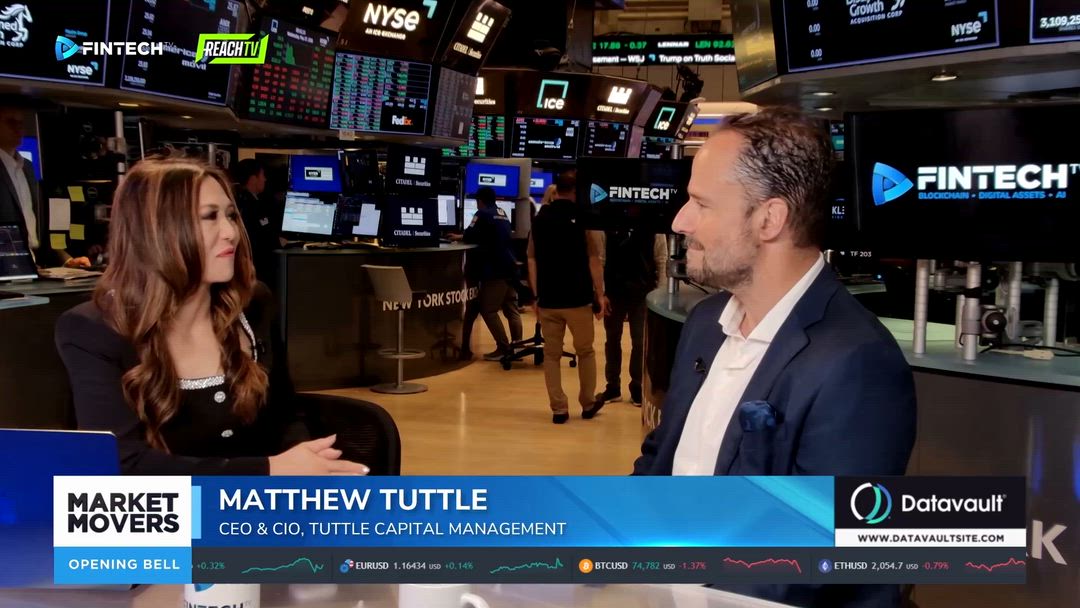
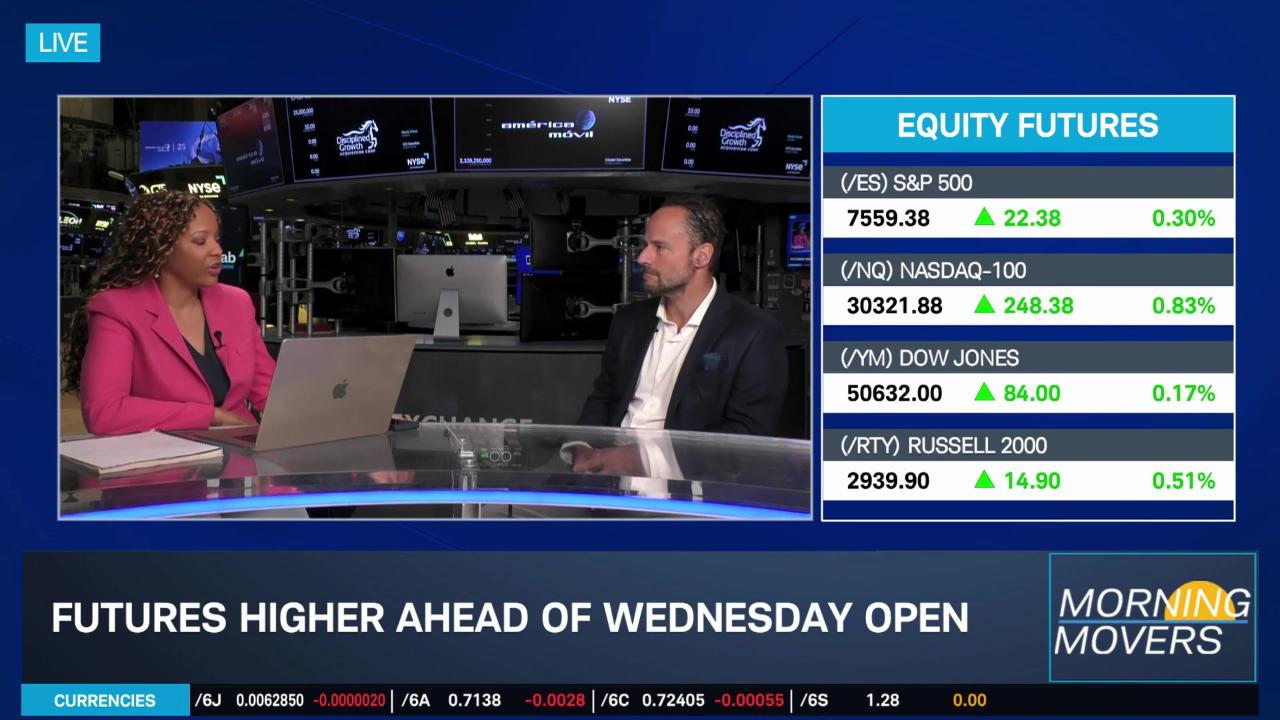
Two areas , I didn’t discuss, but that I’m watching closely, are Bitcoin and precious metals. Neither of them are joining in the speculative frenzy, which doesn’t make a ton of sense. They were down big yesterday and are selling off again this morning. This creates opportunity IMHO, the key is in the timing. The best time to buy these assets is when nobody wants them, probably not today, but at some point soon I suspect there will be a good entry point here. I’m a contrarian, so I do like to see headlines like this….

What Iran Tells Us About UFO Disclosure
When governments confront unknown threats in their airspace, defense budgets surge
and the same aerospace and surveillance companies move hardest. On March 2nd,
Northrop jumped 6% and Lockheed 3.3% on the Iran news — and President Trump has
since ordered the formal release of government UAP files, with the Pentagon confirming
compliance. So if a conventional conflict can move these stocks this fast, what happens
when the bigger story breaks?
See the UFOD holdings: [thetruthisoutthereufod.com
ETF News

A Stock I’m Watching

Drone companies are running this morning, I haven’t seen any news but there must be something. This area has been crushed lately, which creates some great opportunities. I talk a lot about the convergence trade, military melding with AI, and AVAV is one way to play.
In Case You Missed It
Great talk on with the Acquirers Podcast on markets, value investing, inverse Cramer, and Michael Gayed joins me to talk about taking income from your portfolio and how to get more than 4%……
The H.E.A.T. (Hedge, Edge, Asymmetry and Theme) Formula is designed to empower investors to spot opportunities, think independently, make smarter (often contrarian) moves, and build real wealth.
The views and opinions expressed herein are those of the Chief Executive Officer and Portfolio Manager for Tuttle Capital Management (TCM) and are subject to change without notice. The data and information provided is derived from sources deemed to be reliable but we cannot guarantee its accuracy. Investing in securities is subject to risk including the possible loss of principal. Trade notifications are for informational purposes only. TCM offers fully transparent ETFs and provides trade information for all actively managed ETFs. TCM's statements are not an endorsement of any company or a recommendation to buy, sell or hold any security. Trade notification files are not provided until full trade execution at the end of a trading day. The time stamp of the email is the time of file upload and not necessarily the exact time of the trades. TCM is not a commodity trading advisor and content provided regarding commodity interests is for informational purposes only and should not be construed as a recommendation. Investment recommendations for any securities or product may be made only after a comprehensive suitability review of the investor’s financial situation.© 2026 Tuttle Capital Management, LLC (TCM). TCM is a SEC-Registered Investment Adviser. All rights reserved.